x

Resources By Category

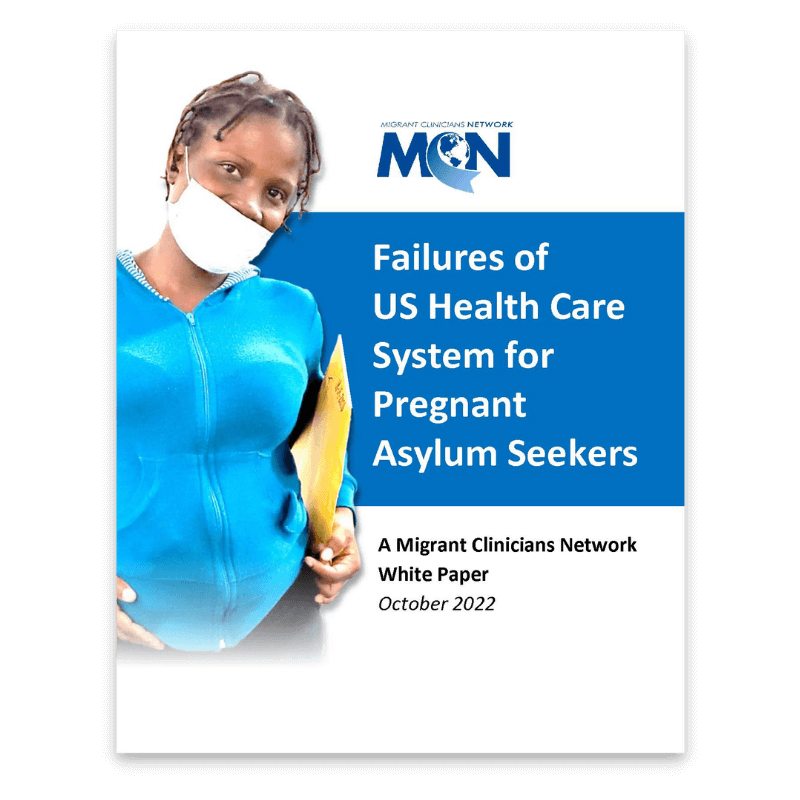
Failures of US Health Care System for Pregnant Asylum Seekers

Migrant Clinicians Network's white paper, “Failures of US Health Care System for Pregnant Asylum Seekers,” outlines how pregnant asylum seekers who have been released into the US to await their asylum hearing face extreme obstacles to secure prenatal care, despite their legal presence within the country.

Without prenatal care, infants will not have the benefit of early screening and treatment for potentially life-threatening diseases and screening for congenital abnormalities, while in utero. Additionally, pregnancies without prenatal care may result in excess utilization of emergency services which produces unforeseen strain on the health care system.

Knowledge of prenatal care needs, cost, lack of insurance, transportation, refusal by health centers, and fear are delineated as key barriers for pregnant asylum seekers from accessing the care they need during their pregnancy.

Press contact: Claire Hutkins Seda, cseda@migrantclinician.org

"The Global Report on Internal Displacement presents the latest information on internal displacement worldwide caused by conflict, violence and disasters."

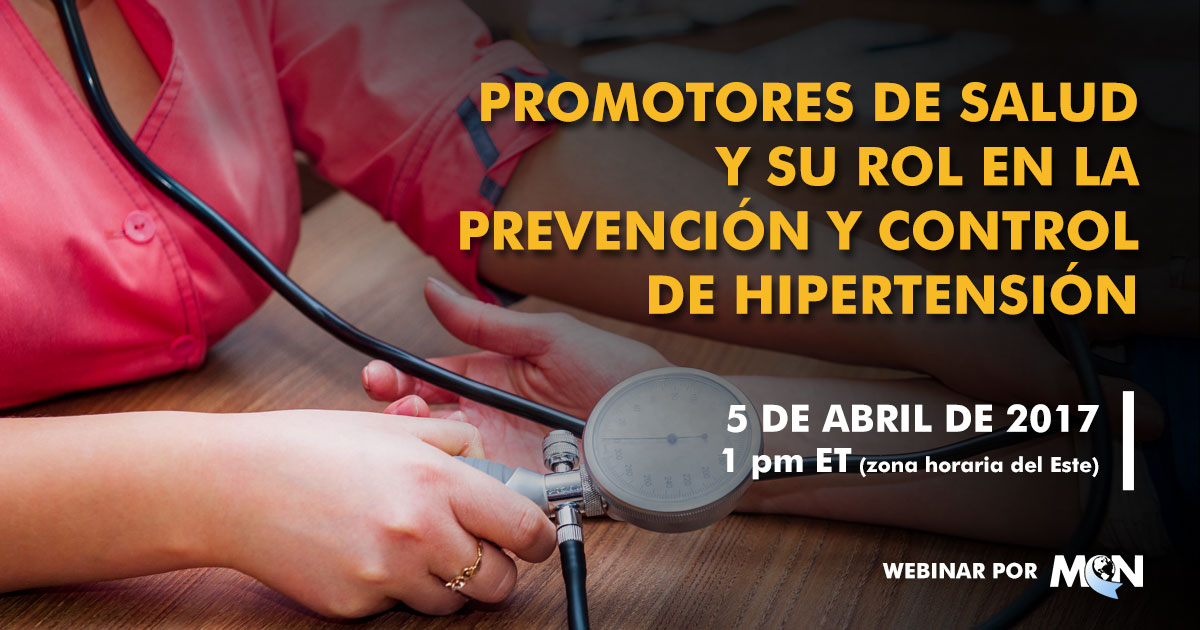
mcn webinar Prevención y Control de Hipertensión


FECHA DE GRABACION: 5 de Abril de 2017, 1 pm ET (zona horaria del Este)

ORADORA: Ileana Ponce-González, MD, MPH, CNC


Crédito de educación continua

Para recibir credito de Trabajador/a de Salud Comunitaria o Educacion de Continua de Enfermera después de ver alguno de estos seminarios usted debe hacer lo siguiente:

  • Completar la evaluación participante asociado a cada webinar
  • Enviar un correo electrónico con su nombre y apellido indicando que ha completado a contedu@migrantclinician.org


Descripción

​En este webinar, los participantes podrán identificar las medidas de desempeño de la Administración de Servicios de Recursos de Salud relacionadas con la hipertensión, describir cómo medir la hipertensión en el cuerpo, entender cómo alentar a los pacientes a controlar y manejar su presión arterial alta y entender las principales barreras que enfrentan pacientes en el control y manejo de su presión arterial alta.


Objetivos de aprendizaje

  1. Identificar los síntomas y signos de presiones sanguíneas altas
  2. Describir cómo se puede medir la hipertensión en el cuerpo
  3. Alentar a los pacientes a controlar y manejar su presión arterial alta
  4. Comprender las principales barreras que enfrentan los pacientes en el control de su presión arterial alta


Lectura Adicional


Este proyecto cuenta con el apoyo de la Administración de Recursos y Servicios de Salud (HRSA) del Departamento de Salud y Servicios Humanos de los Estados Unidos bajo el acuerdo de cooperación número U30CS09742, Asistencia Técnica a Centros de Salud Comunitarios y Migrantes y Personas sin Hogar por $ 1,094,709.00 con 0% del total Proyecto NCA financiado con fuentes no federales. Esta información o contenido y las conclusiones son las del autor y no deben ser interpretadas como la posición o política oficial de, ni cualquier endosos deben ser inferidos por HRSA, HHS o el Gobierno de los Estados Unidos.

Includes EPA manual "How to Comply With the 2015 Revised Worker Protection Standard For Agricultural Pesticides - What Owners and Employers Need To Know" and an excerpt specifically for clininicians regarding medical evaluation and respirator fit test. See also the medical evaluation questions in English and Spanish.  

This 90-minute webinar was created for physicians, nurses, and other health professionals who treat and case manage patients with active TB.  The webinar introduced the 2016 Official American Thoracic Society/Centers for Disease Control and Prevention/Infectious Diseases Society of America Clinical Practice Guidelines: Treatment of Drug-Susceptible Tuberculosis.  This training highlighted the guidelines development process, the key changes in recommendations, and discussed the evidence supporting the changes.  The webinar was originally presented on November 4, 2016. This training was jointly sponsored by all 5 RTMCCs.

Children encounter pesticides daily and have unique susceptibilities to their potential toxicity. Acute poisoning risks are clear, and understanding of chronic health implications from both acute and chronic exposure are emerging. Epidemiologic evidence demonstrates associations between early life exposure to pesticides and pediatric cancers, decreased cognitive function, and behavioral problems.
In this policy statement, the American Association of Pediatrics outlines the symptoms and suggested course of treatment for acute exposure pesticides belonging to the eight most predominant classes of pesticides. The policy statement also makes recommendations for both pediatricians and government to take measures to improve pesticide safety.
© AAP - 2012; This document is copyrighted and is property of the American Academy of Pediatrics and its Board of Directors.

Download Resource

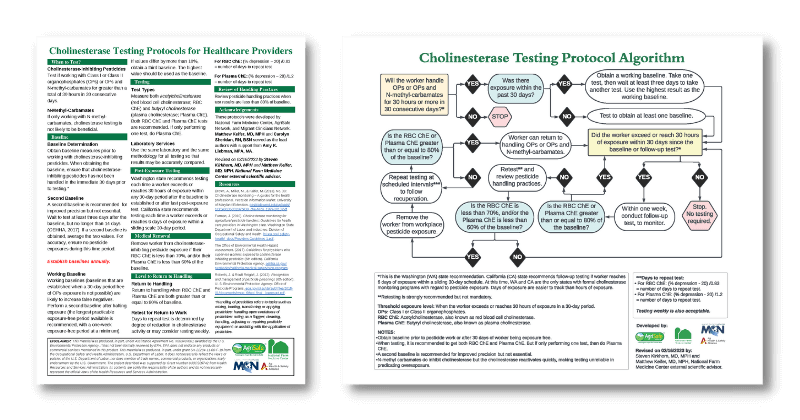
Cholinesterase (ChE) Testing Protocols and Algorithm    

These Cholinesterase (ChE) clinical tools provide a concise and simple format to guide clinicians in monitoring the ChE levels for patients working with Class I and Class II organophosphates (OP) or OP and N-methyl-carbamates. 


MCN's Pesticide Clinical Guidelines and Pesticide Exposure Assessment Form assist in the recognition and management of acute pesticide exposures in primary care settings.

The pesticide guidelines were adapted from guidelines developed by Dr. Dennis H. Penzell, a former medical director of a Community and Migrant Health Center with experience in large-scale pesticide exposure incidents.

The Acute Pesticide Exposure Form was adapted from the data collection on an acute pesticide exposed patient tool developed by Matthew C. Keifer, MD, MPH, Director of the National Farm Medicine Center, appearing in the EPA's Recognition and Management of Pesticide Exposures, 6th Edition, EPA 2013.

These resources were developed with guidance from MCN's Environmental and Occupational Health Advisory Committee - a panel of healthcare professionals and researchers with expertise in pesticides and migrant health.

This issue of Forced Migration Review, features an article about the Strengthening What Works initiative called "Preventing partner violence in refugee and immigrant communities." The article provides an overview of the Robert Wood Johnson Foundation initiative for readers in the humanitarian and public health sectors and features information about MCN's program Hombres Unidos.

Outlines the knowledge and skills that health professionals need to have about pesticides. This document is part of a national initiative aimed at ensuring that pesticides issues become integral elements of education and practice of primary care providers. English and Spanish