This webinar will be provided in English with simultaneous interpretation into Spanish.
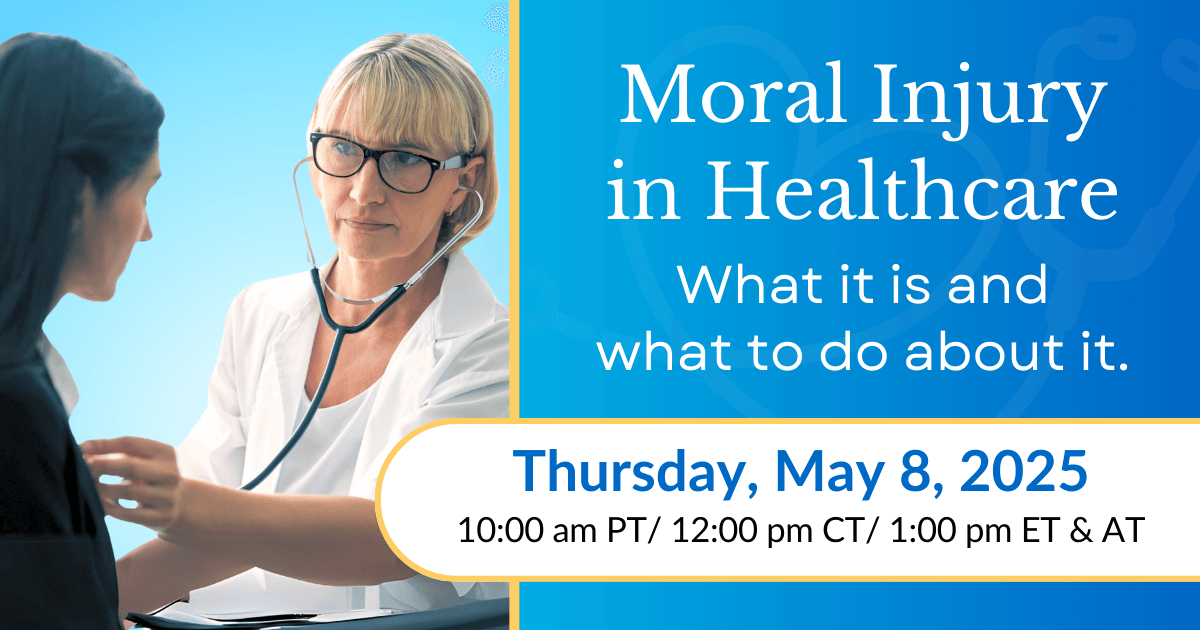
Moral injury is now almost as commonly used as burnout to describe the distress healthcare workers feel. In this webinar, we will provide specific descriptions of what it is, how it differs from other kinds of distress that healthcare workers at all levels of an organization may experience and provide specific suggestions about what to do about it for individuals, teams and organizations. Moral injury harms healthcare workers and impacts the patients they serve. Collective awareness and collective agency can decrease these harms. There will be time to address comments and questions from participants, enacting collective awareness.
At the conclusion of this presentation, participants will be able to…
- Participants will be able to clearly define moral injury and distinguish it from other forms of distress commonly experienced by healthcare workers.
- Participants will be able to identify several components of the wider context that contribute to moral injury.
- Participants will learn actionable strategies to address moral injury on an individual, team, and organizational level through the development of collective awareness and collective agency.
Presenters
Kaethe
Weingarten
Ph.D.
Migrant Clinicians Network
Kaethe Weingarten, Ph.D. (she/her) is the founder the Witness to Witness (W2W) Program. The goal of W2W is to help the helpers, primarily serving health care workers, attorneys and journalists working with vulnerable populations. She received her doctorate from Harvard University in 1974. She has taught at Wellesley College (1975-1979), Harvard Medical School (1981-2017), where she was an Associate Clinical Professor of Psychology in the Department of Psychiatry at Children’s Hospital Boston and then Cambridge Health Alliance, and at the Family Institute of Cambridge (1982-2009). She founded and directed the Program in Families, Trauma and Resilience at the Family Institute of Cambridge. Internationally, she has taught in Africa, Australia, Canada, Europe and New Zealand, where she was a Fullbright Specialist. She has given over 300 presentations and been a keynote speaker at numerous local, national and international conferences. She serves on the editorial boards of five journals. In 2002 she was awarded the highest honor of the American Family Therapy Academy, the award for Distinguished Contribution to Family Theory and Practice. She has written about her work in six books (which she has authored or edited) and over 100 articles, chapters and essays. Her most recent book, Common Shock: Witnessing Violence Every Day- How We Are Harmed, How We Can Heal won the 2004 Nautilus Award for Social Change. Dr. Weingarten’s work focuses on the development and dissemination of a witnessing model. One prong of the work is about the effects of witnessing violence and trauma in the context of domestic, inter-ethnic, racial, political and other forms of conflict. The other prong of the witnessing work is in the context of healthcare, illness and disability. Her work on reasonable hope has been widely cited. In 2013, Dr. Weingarten and her husband moved to Berkeley, CA to be near their children and five grandchildren. There she resumed a dance and choreography practice she had let lapse for forty-five years. Since moving to Berkeley, she and her dance collaborator have been awarded five grants for their choreography with elder dancers applying a witnessing model in public spaces. In 2018 they performed at the Oakland Museum of California. In her spare time she enjoys hiking, baking and crocheting afghans.
Pamela
Secada-Sayles
MPH
Senior Program Manager, Mental Health and Well-Being
Migrant Clinicians Network
Pamela Secada-Sayles, MPH (she/her/ella) is a Peruvian immigrant with ancestral roots to the people of present-day China, Spain, and Italy. She received her Master's in Public Health: Healthcare Policy and Management at University of California, Los Angeles and her Bachelor’s in Anthropology and Chicana/o Studies from California State University, Fullerton. She is currently a doctoral candidate in the Doctor of Education, Organizational Change and Leadership program at the University of Southern California. Her dissertation focus is on examining organizational and leadership practices that have impacted employee wellbeing during the COVID-19 pandemic. Secada-Sayles is passionate about advancing health equity and eliminating health disparities. Her professional career has focused on a wide range of health issues including substance use interventions, review of cultural competency curriculum, community health worker training, and health workforce diversity through educational equity. Secada-Sayles lives in Los Angeles, California with her partner, two stepsons, and their rescue Pitbull, Rocco. When she is not at work or school, she enjoys excessive amounts of sleep, supporting her local dog rescues, watching true crime shows, embarking on new culinary adventures in Los Angeles, laughing, and spending time with her family and friends.