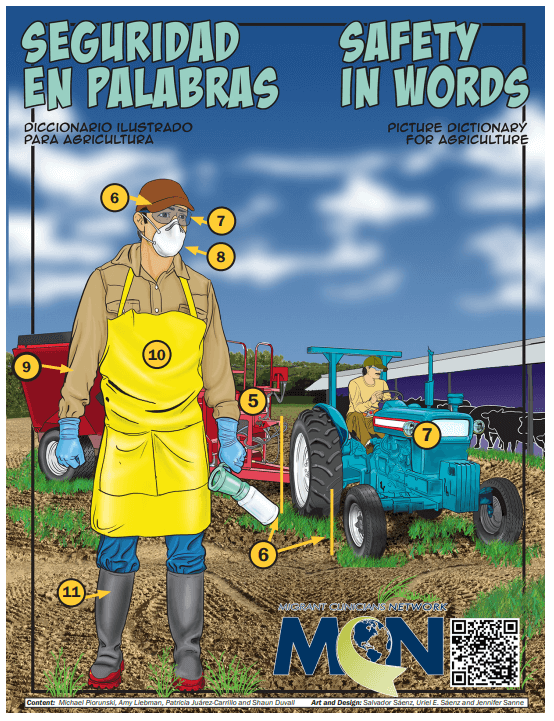
Este diccionario ilustrado bilingüe de MCN, "Seguridad en Palabras/ Safety in Words", muestra los peligros que hay en el lugar de trabajo y las mejores prácticas para la salud y la seguridad en la agricultura. Desarrollado con el apoyo del Programa de Subvenciones Susan Harwood de OSHA, este recurso refuerza el vocabulario en inglés de los trabajadores que hablan español lo que ayudará a prevenir lesiones en la agricultura.
DATE RECORDED: Wednesday, June 17, 2014
PRESENTED BY: Matthew Keifer, MD, MPH, Dean Emanuel Endowed Chair/Director National Farm Medicine Center

![]() |
|
MCN’s Environmental and Occupational Health Programs
Learn more about MCN’s training and technical assistance programs to help clinicians and health centers improve the recognition and management of pesticide exposures and other environmental/occupational health conditions.
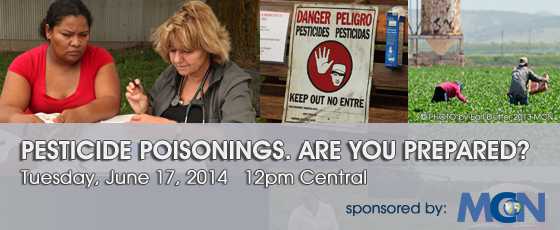
Mistakes can be dangerous. Accurate identification of pesticides responsible for a patient's illness is important to avoid iatrogenic errors with respect to acute treatment. Join us for an important webinar that will focus on key decision points in the diagnosis of pesticide exposures and emphasize the usefulness of the newly revised resource for clinicians - The Recognition and Management of Pesticide Poisonings, 6th ed. Through interactive case studies, this webinar will illustrate effective recognition and treatment of patients over exposed to pesticides.
The webinar, sponsored by Migrant Clinicians Network, the National Farm Medicine Center and AgriSafe Network features Dr. Keifer, a board certified occupational medicine specialist and internationally renowned researcher regarding pesticides and agricultural health and safety. For over 30 years, Dr. Keifer has focused his clinical practice and research largely on farmworkers.
SPONSORED BY: AgriSafe Network, Migrant Clinicians Network, and the National Farm Medicine Center
OBJECTIVES: Participants will be able to:
- Better recognize the signs and symptoms of pesticide overexposure
- Identify key decision points in diagnosing pesticide exposures
- Demonstrate an understanding of how to use The Recognition and Management of Pesticide Poisonings, 6th ed. in a clinical setting
We encourage all participants to order The Recognition and Management of Pesticide Poisonings, 6th ed. prior to attending this webinar. Order here. PDF versions are also available at http://www2.epa.gov/pesticide-worker-safety/recognition-and-management-pesticide-poisonings
If you have experienced any trouble ordering your copy please contact: kbrennan@migrantclinician.org
CLINICAL TOOLS & RESOURCES |
|
PATIENT EDUCATION MATERIALS |
|
ARCHIVED WEBINARS & TRAINING RESOURCES |
|
LOCAL PESTICIDE RESOURCES |
|
The following will provide information regarding the pesticides used in your areas:
|
- http://migrantclinician.adobeconnect.com/p77irjl7cvq/
- http://www.marshfieldclinic.org/nfmc/
- http://www.agrisafe.org/
- http://1.usa.gov/1aF9rHY
- http://www2.epa.gov/pesticide-worker-safety/recognition-and-management-pesticide-poisonings
- http://1.usa.gov/1fFUSZm
- http://bit.ly/1imO43V
- http://npic.orst.edu/
- http://www.aapcc.org/
- http://extoxnet.orst.edu/
- http://www.pesticidemededucation.com/
- http://www.extension.umn.edu/agriculture/pesticide-safety/program-team/
- http://www3.extension.umn.edu/county
- http://web.extension.illinois.edu/psep/about/psepteam.cfm
- http://web.extension.illinois.edu/state/findoffice.cfm
This colorful bilingual comic addresses workers' compensation and immigrant dairy farm workers’ rights and responsibilities. It tells the story of a Mexican dairy farm worker who is injured on the job and the steps he and his employer take to make sure he receives his benefits, and the farm improves its safety.
- DairyWrkrRightsWrkComp_ENG2016_web.pdf (7.78 MB)
- DairyWrkrRightsWrkComp_ESP2016_web.pdf (7.92 MB)
- COMIC - Safety and Health on the Farm - New Mexico - English.pdf (3.4 MB)
- COMIC - Safety and Health on the Farm - New Mexico - Spanish.pdf (3.41 MB)
- COMIC - Safety and Health on the Farm - New York - English.pdf (3.45 MB)
- COMIC - Safety and Health on the Farm - New York - Spanish.pdf (3.46 MB)
- COMIC - Safety and Health on the Farm -Minnesota -English.pdf (7.78 MB)
- COMIC - Safety and Health on the Farm - Minnesota - Spanish_0.pdf (7.91 MB)
MCN's Director of Environmental and Occupational Health, Amy K. Liebman, appeared on the radio broadcast Epicenter: West Marin Issues on KWMR 90.5 FM to talk pesticides and the Worker Protection Standard. Liebman was joined by Hector Sanchez of the Labor Council for Latin American Advancement. Host Frederick Smith discusses with Liebman and Sanchez a variety of pesticide-related issues, including protections for farmworkers and their families, farmworkers' risks of pesticide exposures, how pesticides are regulated, their health effects on farmworkers and their families, and what healthcare providers can do to mitigate, diagnose, manage, and report pesticide exposures.
During the interview Liebman referenced the Agricultural Health Study, which is available here.
- http://kwmr.org/show/186
- http://kwmr.org/show/186','','location=yes,scrollbars=yes,menubar=yes,resizable=yes,width=960,height=720,left='+(screen.availWidth/2-480)+',top='+(screen.availHeight/2-360)+
- http://www.lclaa.org/
- http://aghealth.nih.gov/
- http://aghealth.nih.gov/','','location=yes,scrollbars=yes,resizable=yes,width=960,height=720,left='+(screen.availWidth/2-480)+',top='+(screen.availHeight/2-360)+
- https://w.soundcloud.com/player/?url=http%3A//api.soundcloud.com/tracks/108699853
Señales y síntomas de envenenamiento por pesticidas
Developed by the California Poison Control System in collaboration with the Western Center for Agricultural Health and Safety at the University of California, Davis and the California Department of Pesticide Regulation
The importance of clinical diagnostic tools and biomonitoring of exposures to pesticides as well the role of clinicians in pesticide reporting and the challenges clinicians face in accurately diagnosing patients exposed to pesticides are described in a presentation by Matthew Keifer, MD, MPH and Amy K. Liebman, MPA. Click on the link for an APHA policy resolution underscoring the need for clinical diagnostic tools and biomomitoring of exposures to pesticides. This policy supports the information outlined by in the presentation.
This resource helps you address stigmatization by providing best practices for inhibiting and the actions to take when you encounter stigmatization when new infectious diseases and illness emerge.
Early in an outbreak, such as the 2009 H1N1 outbreak, groups of people, places, and animals can be singled out and will be at risk of being stigmatized by association with the threat this virus poses. Groups are stigmatized by an infectious disease when the risk of infection to others is not present or remote but the association of the risk is magnified by others for that population group, or place or animal.
- CERC Stigmatization fact sheet.doc (89.5 KB)