This 90-minute webinar was created for physicians, nurses, and other health professionals who treat and case manage patients with active TB. The webinar introduced the 2016 Official American Thoracic Society/Centers for Disease Control and Prevention/Infectious Diseases Society of America Clinical Practice Guidelines: Treatment of Drug-Susceptible Tuberculosis. This training highlighted the guidelines development process, the key changes in recommendations, and discussed the evidence supporting the changes. The webinar was originally presented on November 4, 2016. This training was jointly sponsored by all 5 RTMCCs.
DATE RECORDED: Wednesday, June 17, 2014
PRESENTED BY: Matthew Keifer, MD, MPH, Dean Emanuel Endowed Chair/Director National Farm Medicine Center
 |
|
 |
 |
 MCN’s Environmental and Occupational Health Programs
Learn more about MCN’s training and technical assistance programs to help clinicians and health centers improve the recognition and management of pesticide exposures and other environmental/occupational health conditions.
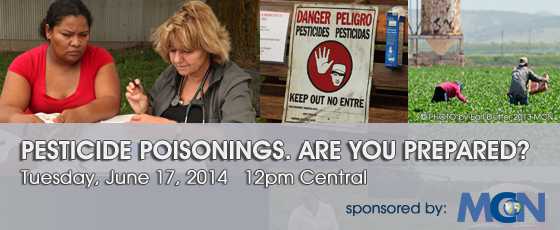
Mistakes can be dangerous. Accurate identification of pesticides responsible for a patient's illness is important to avoid iatrogenic errors with respect to acute treatment. Join us for an important webinar that will focus on key decision points in the diagnosis of pesticide exposures and emphasize the usefulness of the newly revised resource for clinicians - The Recognition and Management of Pesticide Poisonings, 6th ed. Through interactive case studies, this webinar will illustrate effective recognition and treatment of patients over exposed to pesticides.
The webinar, sponsored by Migrant Clinicians Network, the National Farm Medicine Center and AgriSafe Network features Dr. Keifer, a board certified occupational medicine specialist and internationally renowned researcher regarding pesticides and agricultural health and safety. For over 30 years, Dr. Keifer has focused his clinical practice and research largely on farmworkers.
SPONSORED BY: AgriSafe Network, Migrant Clinicians Network, and the National Farm Medicine Center
OBJECTIVES: Participants will be able to:
- Better recognize the signs and symptoms of pesticide overexposure
- Identify key decision points in diagnosing pesticide exposures
- Demonstrate an understanding of how to use The Recognition and Management of Pesticide Poisonings, 6th ed. in a clinical setting
We encourage all participants to order The Recognition and Management of Pesticide Poisonings, 6th ed. prior to attending this webinar. Order here. PDF versions are also available at http://www2.epa.gov/pesticide-worker-safety/recognition-and-management-pesticide-poisonings
If you have experienced any trouble ordering your copy please contact: kbrennan@migrantclinician.org
CLINICAL TOOLS & RESOURCES |
|
PATIENT EDUCATION MATERIALS |
|
ARCHIVED WEBINARS & TRAINING RESOURCES |
|
LOCAL PESTICIDE RESOURCES |
|
The following will provide information regarding the pesticides used in your areas:
|
Links
- http://migrantclinician.adobeconnect.com/p77irjl7cvq/
- http://www.marshfieldclinic.org/nfmc/
- http://www.agrisafe.org/
- http://1.usa.gov/1aF9rHY
- http://www2.epa.gov/pesticide-worker-safety/recognition-and-management-pesticide-poisonings
- http://1.usa.gov/1fFUSZm
- http://bit.ly/1imO43V
- http://npic.orst.edu/
- http://www.aapcc.org/
- http://extoxnet.orst.edu/
- http://www.pesticidemededucation.com/
- http://www.extension.umn.edu/agriculture/pesticide-safety/program-team/
- http://www3.extension.umn.edu/county
- http://web.extension.illinois.edu/psep/about/psepteam.cfm
- http://web.extension.illinois.edu/state/findoffice.cfm
Haz-Map® is an occupational health database designed for health and safety professionals and for consumers seeking information about the adverse effects of workplace exposures to chemical and biological agents. The main links in Haz-Map are between chemicals and occupational diseases. These links have been established using current scientific evidence.
Links
Children encounter pesticides daily and have unique susceptibilities to their potential toxicity. Acute poisoning risks are clear, and understanding of chronic health implications from both acute and chronic exposure are emerging. Epidemiologic evidence demonstrates associations between early life exposure to pesticides and pediatric cancers, decreased cognitive function, and behavioral problems.
In this policy statement, the American Association of Pediatrics outlines the symptoms and suggested course of treatment for acute exposure pesticides belonging to the eight most predominant classes of pesticides. The policy statement also makes recommendations for both pediatricians and government to take measures to improve pesticide safety.
© AAP - 2012; This document is copyrighted and is property of the American Academy of Pediatrics and its Board of Directors.
Download Resource
- PestExposureChild_Policy_AAP.pdf (523.63 KB)
This issue of Forced Migration Review, features an article about the Strengthening What Works initiative called "Preventing partner violence in refugee and immigrant communities." The article provides an overview of the Robert Wood Johnson Foundation initiative for readers in the humanitarian and public health sectors and features information about MCN's program Hombres Unidos.
The importance of clinical diagnostic tools and biomonitoring of exposures to pesticides as well the role of clinicians in pesticide reporting and the challenges clinicians face in accurately diagnosing patients exposed to pesticides are described in a presentation by Matthew Keifer, MD, MPH and Amy K. Liebman, MPA. Click on the link for an APHA policy resolution underscoring the need for clinical diagnostic tools and biomomitoring of exposures to pesticides. This policy supports the information outlined by in the presentation.
Download Resource
The Toolkit is a combination of easy-to-use reference guides for health providers and user friendly health education materials on preventing exposures to toxic chemicals and other substances that affect infant and child health.
Links
Pesticide Program: Illness Monitoring and Prevention
1-800-858-7378 or npic@ace.orst.edu
Beyond Pesticides/National Coalition Against the Misuse of Pesticides provides pesticide fact sheets, action alerts and information on what to do in a pesticide emergency.
Northwest Coalition for Alternatives to Pesticides - promotes healthy solutions to pest problems and publishes the Journal on Pesticide Reform.
Pesticide Action Network of North America - promotes healthier, more effective pest management and houses the Pesticide Action Network Pesticide Database - a database of pesticide toxicity and regulatory information. The reference section provides general information about pesticides and their health effects.
Links