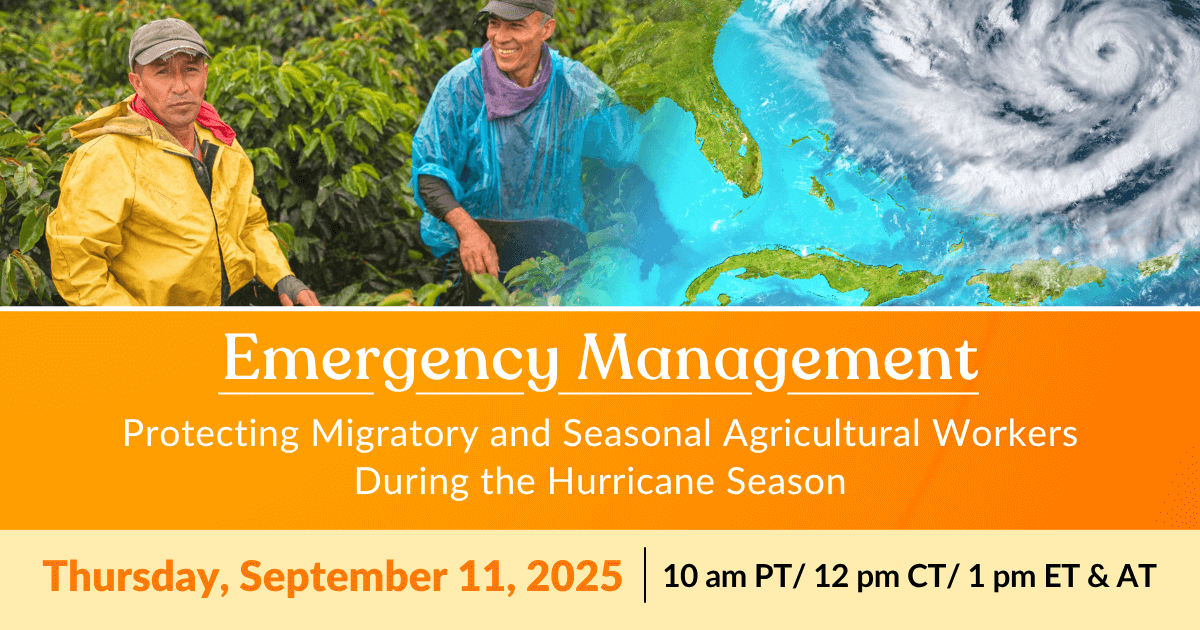
* This webinar will be provided in Spanish with simultaneous interpretation into English *
Recent weather-related disasters across the US have highlighted the urgent need for targeted emergency preparedness strategies that address the unique vulnerabilities of migratory and seasonal agricultural workers (MSAWs) and their employers. This webinar will explore the health-related impacts of weather emergencies on MSAWs and the agricultural communities that surround and support this workforce. Participants will gain a deeper understanding of the specific challenges faced by MSAWs before, during, and after disasters, and how these events affect both worker well-being and employer operations. The session will also introduce prevention and mitigation strategies that health centers and employers can adapt to protect this essential workforce. Through a discussion of the role of health centers as emergency response hubs, the webinar will emphasize the importance of whole-community planning, identification of community health needs, and community safety in disaster preparedness efforts .
Watch the Webinar Recording
Download the Presentation Slides
Take the Evaluation
At the conclusion of this presentation, participants will be able to…
- Understand the health-related factors for weather-related emergencies and disasters in the US
- Describe the impact of hurricanes on MSAWs and employers
- Explore and adapt prevention and mitigation actions for MSAWs and employers during emergencies.
Presenters

Marysel
Pagán Santana
DrPH, MS
Director of Environmental and Occupational Health, Senior Program Manager for Puerto Rico
Migrant Clinicians Network
Marysel Pagán Santana, DrPH, MS, serves as Director of Environmental and Occupational Health of Migrant Clinicians Network in Puerto Rico, where she leads and coordinates MCN projects related to occupational health, disaster preparedness, and emergency response. She is also the organization's lead for the Caribbean Office. Dr. Pagán Santana provides technical assistance, training, and tool development for community health centers in Puerto Rico and the communities they serve to address disaster-related issues and health-related impacts. Additionally, she is the project director of a USDA-funded project to support resiliency among farmworkers in Puerto Rico and the US Virgin Islands. She also provides training related to occupational health and safety to different populations of workers in Puerto Rico. Dr. Pagán Santana has extensive experience providing training to vulnerable and high-risk worker populations and carrying out community projects. She also has over eight years of experience in the private sector as an industrial hygienist and continues to offer them her professional consulting in the development and implementation of training programs in occupational and environmental health, emergency preparedness, and business continuity planning. In recent years, Dr. Pagán Santana has focused on assisting the response to COVID-19 in educational institutions in Puerto Rico, as well as supporting the PR Department of Health's response by offering training to personnel responsible for monitoring schools and businesses to promote the health of students and essential personnel in Puerto Rico. Dr. Pagán Santana has a Master’s degree in Industrial Hygiene and a Doctorate in Public Health with an emphasis on environmental health from the Medical Sciences Campus of the University of Puerto Rico.
Continuing Education Credit (CEU)
Application for CME credit has been filed with the American Academy of Family Physicians. Determination of credit is pending.
Migrant Clinicians Network is accredited as a provider of nursing continuing professional development by the American Nurses Credentialing Center's Commission on Accreditation.