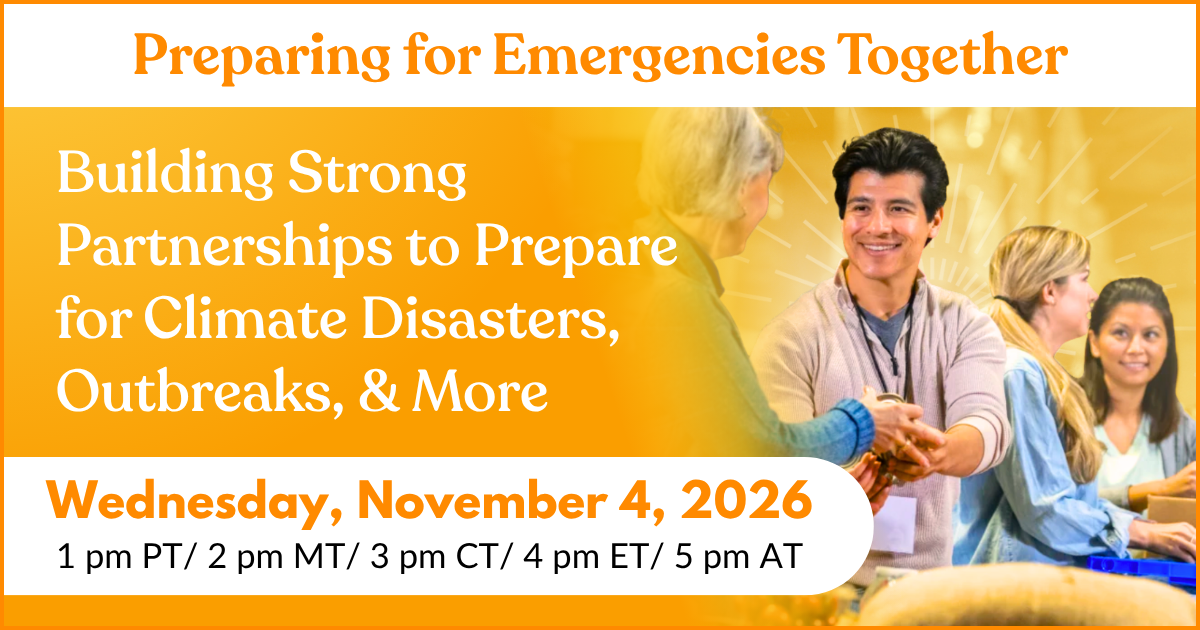
A Clinical Perspective and Exploration of Best Practices
Climate-related emergencies and infectious disease outbreaks can have serious impacts on underserved populations, including rural and urban communities, agricultural workers, and immigrants. These populations face significant and growing barriers to care and are often overlooked when disaster strikes. How do we address one disaster when it is layered on top of pre-existing disasters and health disparities? Strong partnerships between state and local health departments and community-based organizations that serve these populations are an important aspect of the response to help clinicians and communities access information and critical resources in a timely manner.
In this webinar, participants will explore emergency preparedness planning strategies, partnership best practices, and practical resources that health centers, clinicians, community partners, and emergency preparedness coordinators can use to strengthen coordination and response efforts. The session will highlight examples of how partnerships have been effective in responding to real emergencies in a variety of settings and will provide resources from emergency preparedness experts that can be shared and adapted.
More details coming soon!

At the conclusion of the presentation, participants will be able to…
- Define emergency preparedness and describe 3 examples of when emergency preparedness is needed.
- List 3 strategies for building strong relationships with all partners involved in emergency preparedness, including government agencies and community-based organizations.
- Identify 3 resources to support emergency preparedness in migrant and immigrant communities.
Presenters

Dr. Matthew Donahue is an Iowan, an Internal Medicine Physician, and the Iowa State Epidemiologist. Domestically he has developed surveillance systems for novel health emergencies and led responses to numerous outbreaks and public health emergencies; internationally he has worked with patients with HIV and opportunistic infections in South Africa, helped grow a global health program in rural Peru, and led response teams during a polio response in Ghana. He trained through CDC’s Epidemic Intelligence Service and holds a Certificate of Knowledge in Clinical Tropical Medicine and Travelers’ Health. He continues practicing medicine one day per week at a local health department and his authored or coauthored scientific publications have been cited more than 3,000 times. In addition to his work in epidemiology and medicine, he greatly enjoys adventures with his wife and two daughters.

Dulce Arroyo is a social work professional with more than 8 years of experience leading complex initiatives across healthcare, government, nonprofit, and community-based settings. Throughout her career, Dulce has led statewide initiatives focused on healthcare access, community engagement, and public health response. She has managed grant activities, coordinated cross-functional teams and diverse stakeholder groups, facilitated training for outreach professionals, and developed processes designed to improve program efficiency, accountability, and service delivery. Currently with the North Carolina Department of Health and Human Services, Dulce is part of the North Carolina Farmworker Health Program where she supports the program’s funded sites by providing technical assistance, monitoring budgets and contracts, and being the point of contact for emergency preparedness and response.

Max Hadler is the Senior Director of Policy and Immigrant Initiatives in the Office of Health Care Access and Policy at the New York City Health Department, where he works on a range of issues to improve health access, coverage, and delivery for immigrant communities. Prior to joining the Health Department, he held a range of related positions including Director of Health Policy at the New York Immigration Coalition, Project Director and Research Associate at the UCLA Center for Health Policy Research, Researcher at the UCLA North American Integration and Development Center, and Spanish-English Medical Interpreter at Yale-New Haven Hospital.
Continuing Education Credit (CEU)
Migrant Clinicians Network is accredited as a provider of nursing continuing professional development by the American Nurses Credentialing Center’s Commission on Accreditation.
An application for continuing medical education (CME) credit has been filed with the American Academy of Family Physicians. Determination of credit is pending.