Includes EPA manual "How to Comply With the 2015 Revised Worker Protection Standard For Agricultural Pesticides - What Owners and Employers Need To Know" and an excerpt specifically for clininicians regarding medical evaluation and respirator fit test. See also the medical evaluation questions in English and Spanish.
Download Resource
DATE: February 21, 2017
SPEAKERS: Ed Zuroweste, MD
Continuing Education Credit
To receive CME* or CNE credit after viewing this webinar, you must:
- Complete the Participant Evaluation associated with this webinar
- Send an email with your first and last name stating which webinar you completed to contedu@migrantclinician.org
Description
Agriculture is also one of the most dangerous industries in the United States. For vulnerable populations working in agriculture, their lack of training, poor safety precautions, regulatory exclusions, lack of health insurance, language barriers, piece-rate pay, immigration status, and geographical and cultural isolation can put these workers at increased risk for occupationally related injuries and illnesses and chronic sequelae. Exposure to pesticides and other contaminants is a particular concern to agricultural workers and their families. This continuing education training will discuss health risks facing immigrant and migrant agricultural workers and their families as a result of their working conditions and environment, with a particular focus on Kansas. It will also highlight best practices and resources for the incorporation of environmental and occupational health in the practice setting, showcasing successful initiatives in primary care settings. Participants will explore the importance of and become familiar with the methods to integrate environmental and occupational health into the practice setting from the clinical perspective as well as consider these issues within the framework of social determinants of health.
Resources
- MCN's Environmental and Occupational Health Program (Migrant Health Center Partnership Description)
- MCN's EOH Screening Tool
- Farmworker Clinicians Manual
- Pesticide Reporting and Workers’ Compensation in Agriculture - Interactive Map
- EPA Recognition and Management of Pesticide Poisonings
- MCN & Farmworker Justice Clinician Guides for Farmworker Health and Safety Regulations
- Patient Education Materials
- Immigrant Dairy Worker Health and Safety
- iCuídate!, a comic book aimed at preventing musculoskeletal injuries among farmworkers
- Pesticide Comic Books
This material was produced, in part, under Assistance Agreement No. X883487601 awarded by the U.S. Environmental Protection Agency. It has not been formally reviewed by EPA. EPA does not endorse any products or commercial services mentioned in this product.
Substance Use Warmline
Peer-to-Peer Consultation and Decision Support
10 am – 6 pm EST Monday - Friday
855-300-3595
Free and confidential consultation for clinicians from the Clinician Consultation Center at San Francisco General Hospital focusing on substance use in primary care
Objectives of the Substance Use Warmline:
- Support primary care providers in managing complex patients with addiction, chronic pain, and behavioral health issues
- Improve the safety of medication regimens to decrease the risk of overdose
- Enhance the treatment, care and support for people living with or at risk for HIV
- Discuss useful strategies for clinicians in managing their patients living with substance use, addiction and chronic pain.
Consultation topics include:
- Assessment and treatment of opioid, alcohol, and other substance use disorders
- Approaches to suspected misuse, abuse, or diversion of prescribed opioids
- Methods to simplify opioid-based pain regimens to reduce risk of misuse and toxicity
- Urine toxicology testing- when to use it and what it means
- Use of buprenorphine and the role of methadone maintenance
- Withdrawal management for opioids, alcohol, and other CNS depressants
- Harm reduction strategies and overdose prevention
- Managing substance use in special populations (pregnancy, HIV, hepatitis)
- Productive ways of discussing (known or suspected) addiction with patients.
The CCC’s multi-disciplinary team of expert physicians, clinical pharmacists and nurses provides consultation to help clinicians manage complex patient needs, medication safety, and a rapidly evolving regulatory environment.
Learn more at http://nccc.ucsf.edu/clinician-consultation/substance-use-management
Download Resource
- CCC Substance Use Warmline Flier EST 7.25.16.pdf (112.12 KB)
This 90-minute webinar was created for physicians, nurses, and other health professionals who treat and case manage patients with active TB. The webinar introduced the 2016 Official American Thoracic Society/Centers for Disease Control and Prevention/Infectious Diseases Society of America Clinical Practice Guidelines: Treatment of Drug-Susceptible Tuberculosis. This training highlighted the guidelines development process, the key changes in recommendations, and discussed the evidence supporting the changes. The webinar was originally presented on November 4, 2016. This training was jointly sponsored by all 5 RTMCCs.
Download Resource
An educational comic book on the prevention of zoonotic illnesses. Developed by MCN in collaboration with Ohio State University.
Download Resource
- Working with farm animals_1.pdf (13.33 MB)
- Trabajos con animales en un rancho_1.pdf (13.31 MB)
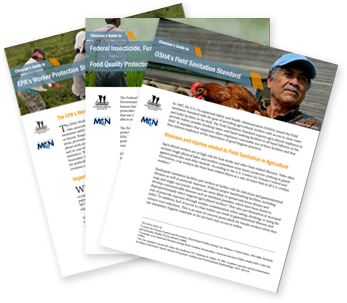
MCN and Farmworker Justice offer these guides to assist clinicians in understanding farmworker health and safety regulations. OSHA’s Field Sanitation Standard; EPA's Federal Insecticide, Fungicide, and Rodenticide Act (FIFRA); EPA's Food Quality Protection Act (FQPA); EPA’s Worker Protection Standard (WPS).
Download Resource
- OSHA's Field Sanitation Standard Clinician's Guide.pdf (747.53 KB)
- FIFRA FQPA Clinician Guide.pdf (287.9 KB)
- WPS Clinician's Guide.pdf (843.35 KB)
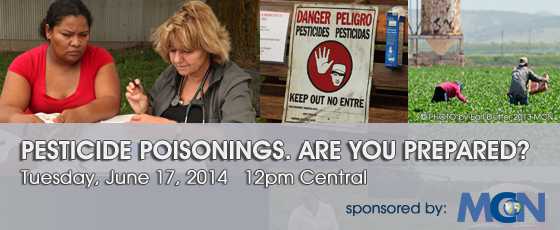
DATE RECORDED: Wednesday, June 17, 2014
PRESENTED BY: Matthew Keifer, MD, MPH, Dean Emanuel Endowed Chair/Director National Farm Medicine Center
 |
|
 |
 |
 MCN’s Environmental and Occupational Health Programs
Learn more about MCN’s training and technical assistance programs to help clinicians and health centers improve the recognition and management of pesticide exposures and other environmental/occupational health conditions.
Mistakes can be dangerous. Accurate identification of pesticides responsible for a patient's illness is important to avoid iatrogenic errors with respect to acute treatment. Join us for an important webinar that will focus on key decision points in the diagnosis of pesticide exposures and emphasize the usefulness of the newly revised resource for clinicians - The Recognition and Management of Pesticide Poisonings, 6th ed. Through interactive case studies, this webinar will illustrate effective recognition and treatment of patients over exposed to pesticides.
The webinar, sponsored by Migrant Clinicians Network, the National Farm Medicine Center and AgriSafe Network features Dr. Keifer, a board certified occupational medicine specialist and internationally renowned researcher regarding pesticides and agricultural health and safety. For over 30 years, Dr. Keifer has focused his clinical practice and research largely on farmworkers.
SPONSORED BY: AgriSafe Network, Migrant Clinicians Network, and the National Farm Medicine Center
OBJECTIVES: Participants will be able to:
- Better recognize the signs and symptoms of pesticide overexposure
- Identify key decision points in diagnosing pesticide exposures
- Demonstrate an understanding of how to use The Recognition and Management of Pesticide Poisonings, 6th ed. in a clinical setting
We encourage all participants to order The Recognition and Management of Pesticide Poisonings, 6th ed. prior to attending this webinar. Order here. PDF versions are also available at http://www2.epa.gov/pesticide-worker-safety/recognition-and-management-pesticide-poisonings
If you have experienced any trouble ordering your copy please contact: kbrennan@migrantclinician.org
CLINICAL TOOLS & RESOURCES |
|
PATIENT EDUCATION MATERIALS |
|
ARCHIVED WEBINARS & TRAINING RESOURCES |
|
LOCAL PESTICIDE RESOURCES |
|
The following will provide information regarding the pesticides used in your areas:
|
Links
- http://migrantclinician.adobeconnect.com/p77irjl7cvq/
- http://www.marshfieldclinic.org/nfmc/
- http://www.agrisafe.org/
- http://1.usa.gov/1aF9rHY
- http://www2.epa.gov/pesticide-worker-safety/recognition-and-management-pesticide-poisonings
- http://1.usa.gov/1fFUSZm
- http://bit.ly/1imO43V
- http://npic.orst.edu/
- http://www.aapcc.org/
- http://extoxnet.orst.edu/
- http://www.pesticidemededucation.com/
- http://www.extension.umn.edu/agriculture/pesticide-safety/program-team/
- http://www3.extension.umn.edu/county
- http://web.extension.illinois.edu/psep/about/psepteam.cfm
- http://web.extension.illinois.edu/state/findoffice.cfm
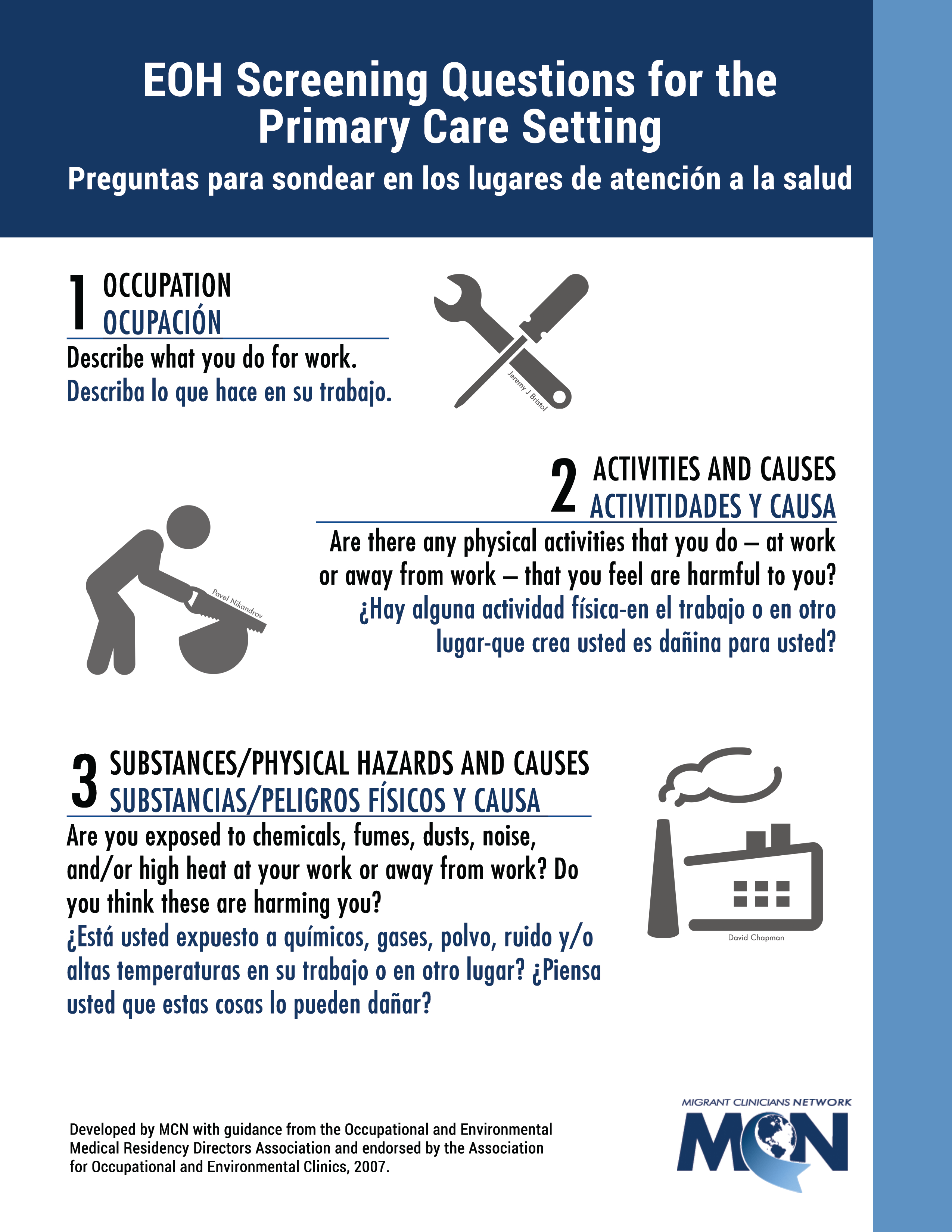
Three concise and effective environmental/occupational health screening questions for the primary care provider. English and Spanish. MCN, 2014.
An EHR-friendly version of these screening questions was developed through MCN's Workers & Health Program. This can be used as a reference for integration into the health center's Electronic Health Record.
Download Resource
- EOHScreeningQs_2014Nov.pdf (3.99 MB)
- EOHScreeningQs_EHR_2014Nov.pdf (4.49 MB)
Haz-Map® is an occupational health database designed for health and safety professionals and for consumers seeking information about the adverse effects of workplace exposures to chemical and biological agents. The main links in Haz-Map are between chemicals and occupational diseases. These links have been established using current scientific evidence.
Links
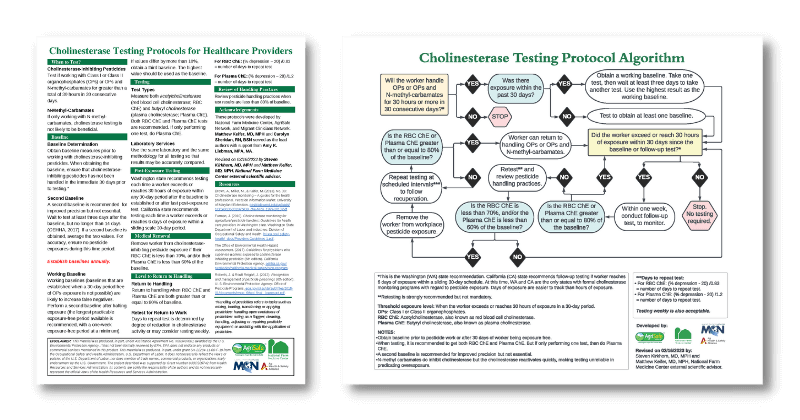
These Cholinesterase (ChE) clinical tools provide a concise and simple format to guide clinicians in monitoring the ChE levels for patients working with Class I and Class II organophosphates (OP) or OP and N-methyl-carbamates.
Download Resource
MCN's Pesticide Clinical Guidelines and Pesticide Exposure Assessment Form assist in the recognition and management of acute pesticide exposures in primary care settings.
The pesticide guidelines were adapted from guidelines developed by Dr. Dennis H. Penzell, a former medical director of a Community and Migrant Health Center with experience in large-scale pesticide exposure incidents.
The Acute Pesticide Exposure Form was adapted from the data collection on an acute pesticide exposed patient tool developed by Matthew C. Keifer, MD, MPH, Director of the National Farm Medicine Center, appearing in the EPA's Recognition and Management of Pesticide Exposures, 6th Edition, EPA 2013.
These resources were developed with guidance from MCN's Environmental and Occupational Health Advisory Committee - a panel of healthcare professionals and researchers with expertise in pesticides and migrant health.
Download Resource
- PesticideClinicalGuidelines_2014Nov.pdf (395.73 KB)
- 2022-Pesticide-Exp-Assessment_ENG.pdf (316.56 KB)
- 2016-08-16 - Acute Pesticide Exposures Clinical Guidelines (Spanish).pdf (203.88 KB)
- 2022_Pesticide-Exp-Assessment_SPA.pdf (626.33 KB)
The importance of clinical diagnostic tools and biomonitoring of exposures to pesticides as well the role of clinicians in pesticide reporting and the challenges clinicians face in accurately diagnosing patients exposed to pesticides are described in a presentation by Matthew Keifer, MD, MPH and Amy K. Liebman, MPA. Click on the link for an APHA policy resolution underscoring the need for clinical diagnostic tools and biomomitoring of exposures to pesticides. This policy supports the information outlined by in the presentation.
Download Resource
The Toolkit is a combination of easy-to-use reference guides for health providers and user friendly health education materials on preventing exposures to toxic chemicals and other substances that affect infant and child health.
Links
Pesticide Program: Illness Monitoring and Prevention
Outlines the knowledge and skills that health professionals need to have about pesticides. This document is part of a national initiative aimed at ensuring that pesticides issues become integral elements of education and practice of primary care providers. English and Spanish
Download Resource
- NEETFPesticidePracticeGuidelines.pdf (2.04 MB)
- NEETFHabilidadesParaLaPracticaPesticidas.pdf (668.29 KB)
1-800-858-7378 or npic@ace.orst.edu
American Association of Poison Control Centers Offers a listing of regional Poison Control Centers. Poison Control Centers provide information regarding possible or actual environmental or occupational exposures and recommended treatments. The website offers education for children and adults.
Links
Beyond Pesticides/National Coalition Against the Misuse of Pesticides provides pesticide fact sheets, action alerts and information on what to do in a pesticide emergency.
Northwest Coalition for Alternatives to Pesticides - promotes healthy solutions to pest problems and publishes the Journal on Pesticide Reform.
Pesticide Action Network of North America - promotes healthier, more effective pest management and houses the Pesticide Action Network Pesticide Database - a database of pesticide toxicity and regulatory information. The reference section provides general information about pesticides and their health effects.
Links
The manual is a guide that can be used by community workers, educators, and health promoters for their educational activities in the community. It provides information on the risks of exposure to environmental contaminants and pesticides and ways to reduce those risks. It also includes useful information and tips for working in the community.
As for the comic book, community workers, educators and health promoters can use it as an educational tool to inform their community about the risks of environmental contaminants and pesticides.
Download Resource
- pocovenenocomicless20.pdf (16.8 MB)
- A LITTLE POISON WILL IT KILL YOU_June-2019.pdf (5.14 MB)
- Poco Veneno No Mata 2nd Edition - June2019.pdf (5.27 MB)