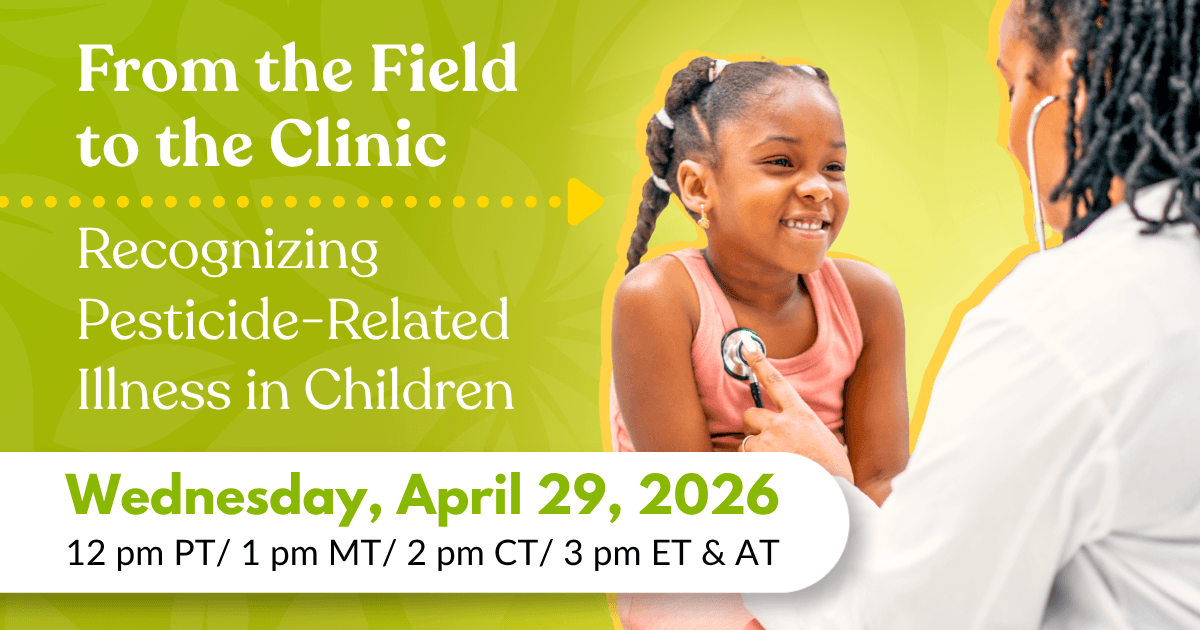
Pesticide exposure is a common concern in agricultural and rural communities, and children are particularly susceptible to its health effects. This accredited CME/CNE webinar is designed to help clinicians strengthen their ability to recognize and manage pesticide-related illness in pediatric patients. In this webinar, we will review the acute and chronic health effects of pesticide exposure in children and adolescents, common exposure routes, and current evidence linking early-life exposure to developmental and health outcomes. Through case studies, we will highlight exposure scenarios and clinical presentations frequently encountered in farmworker communities. We will also introduce participants to the Recognition and Management of Pesticide Poisonings, 6th edition and provide patient education materials to support clinical decision making and prevention strategies.
Watch the Webinar Recording
Download the Presentation Slides
Take the Evaluation
At the conclusion of the presentation, participants will be able to:
- Recognize the signs and symptoms of pesticide exposure in children and adolescents, including common exposure routes.
- Identify common pediatric exposure scenarios in rural and agricultural settings.
- Describe clinical and patient resources to help recognize, manage, and prevent pesticide-related illness.
Presenters

James R. Roberts, Dr.
Professor of Pediatrics
Medical University of South Carolina
Dr. James R. Roberts is a Professor of Pediatrics at the Medical University of South Carolina, where he has served on the faculty since 1997. Dr. Roberts is a graduate of Texas Tech University School of Medicine, Lubbock, Texas, and completed his Fellowship in General Academic Pediatrics along with a Master of Public Health at the University of Alabama at Birmingham.
Dr. Roberts is nationally recognized for his work in pediatric environmental health, particularly in the areas of lead poisoning and pesticide exposure. He is a former member of the American Academy of Pediatrics Committee on Environmental Health, contributing to national policy statements, technical reports, and multiple editions of the AAP Handbook on Pediatric Environmental Health. His expertise has shaped state and federal guidance, including CDC recommendations on managing elevated blood lead levels and the EPA’s Recognition and Management of Pesticide Poisoning.
He currently directs a pediatric practice‑based research network in South Carolina, serves as an NIH‑funded investigator focused on improving childhood obesity management, and is a Co‑investigator with the national ECHO Cohort study. Dr. Roberts is also an award‑winning educator recognized by MUSC pediatric residents.

Amy Liebman, MPA, MA
Chief Program Officer
Migrant Clinicians Network
Amy K. Liebman, MPA, MA has devoted her career to improving the safety and health of disenfranchised populations. She joined Migrant Clinicians Network (MCN) in 1999 and currently serves as the Chief Program Officer. With MCN she has established nationally recognized initiatives to improve the health and safety of workers and their families, including foreign-born workers.
She oversees programs ranging from integrating occupational and environmental medicine into primary care to designing worker safety interventions. She is a national leader in addressing worker safety through the community health worker (CHW) model. She has been a strong advocate for worker health and safety during the COVID-19 pandemic, leading programs to improve access to care and education for migrants and immigrants. Prior to her current position, she directed numerous environmental health projects along the US-Mexico Border including an award-winning, community-based hygiene education program that reached thousands of families living without water and sewerage services.
She has spearheaded policy efforts within the American Public Health Association to support the protection of agricultural workers and served on the federal advisory committee to the EPA Office of Pesticide Programs. Her programs have won several awards including the 2008 EPA Children’s Environmental Health Champion Award and the 2015 National Safety Council Research Collaboration Award. In 2011, Liebman received the Lorin Kerr Award, an APHA/Occupational Health and Safety Section honor recognizing public health professionals for their dedication and sustained efforts to improve the lives of workers. In 2024, she was honored with the Shelley Davis Humanitarian Award for her commitment to improving farmworker health and safety. She is a past Chair of APHA’s Occupational Health and Safety. Liebman has been the principal investigator and project manager of numerous government and privately sponsored projects. She has authored articles, bilingual training manuals and other educational materials dealing with environmental and occupational health and migrants. Liebman has a master’s degree from the LBJ School of Public Affairs at the University of Texas at Austin, and a Master of Arts from the Institute of Latin American Studies at the University of Texas at Austin.
Continuing Education Credit (CEU)
Migrant Clinicians Network is accredited as a provider of nursing continuing professional development by the American Nurses Credentialing Center’s Commission on Accreditation. This presentation has been approved for continuing nursing education.

An application for continuing medical education (CME) credit has been filed with the American Academy of Family Physicians. Determination of credit is pending.