The importance of clinical diagnostic tools and biomonitoring of exposures to pesticides as well the role of clinicians in pesticide reporting and the challenges clinicians face in accurately diagnosing patients exposed to pesticides are described in a presentation by Matthew Keifer, MD, MPH and Amy K. Liebman, MPA. Click on the link for an APHA policy resolution underscoring the need for clinical diagnostic tools and biomomitoring of exposures to pesticides. This policy supports the information outlined by in the presentation.
This resource helps you address stigmatization by providing best practices for inhibiting and the actions to take when you encounter stigmatization when new infectious diseases and illness emerge.
Early in an outbreak, such as the 2009 H1N1 outbreak, groups of people, places, and animals can be singled out and will be at risk of being stigmatized by association with the threat this virus poses. Groups are stigmatized by an infectious disease when the risk of infection to others is not present or remote but the association of the risk is magnified by others for that population group, or place or animal.
Files
- CERC Stigmatization fact sheet.doc (89.5 KB)
The Toolkit is a combination of easy-to-use reference guides for health providers and user friendly health education materials on preventing exposures to toxic chemicals and other substances that affect infant and child health.
Links
copy deeplink Breathing Easy at Home/Una Casa Libre de Problemas Respiratorios
Breathing Easy at Home/Una Casa Libre de Problemas RespiratoriosEducational comic book about the sources of indoor pollution and ways to minimize exposure. Offers safe alternatives to clean homes. English and Spanish.
Files
- BreathingEasyComicEng.pdf (2.36 MB)
- UnaCasaLibreDeProblemasRespiratorias.pdf (2.85 MB)
copy deeplink National Pesticide Practice Skills Guidelines for Medical and Nursing Practice
National Pesticide Practice Skills Guidelines for Medical and Nursing PracticeOutlines the knowledge and skills that health professionals need to have about pesticides. This document is part of a national initiative aimed at ensuring that pesticides issues become integral elements of education and practice of primary care providers. English and Spanish
Files
- NEETFPesticidePracticeGuidelines.pdf (2.04 MB)
- NEETFHabilidadesParaLaPracticaPesticidas.pdf (668.29 KB)
copy deeplink Pesticides Nearby But Healthy: A Guide to Protect Children from Pesticides | Comic
Pesticides Nearby But Healthy: A Guide to Protect Children from Pesticides | Comic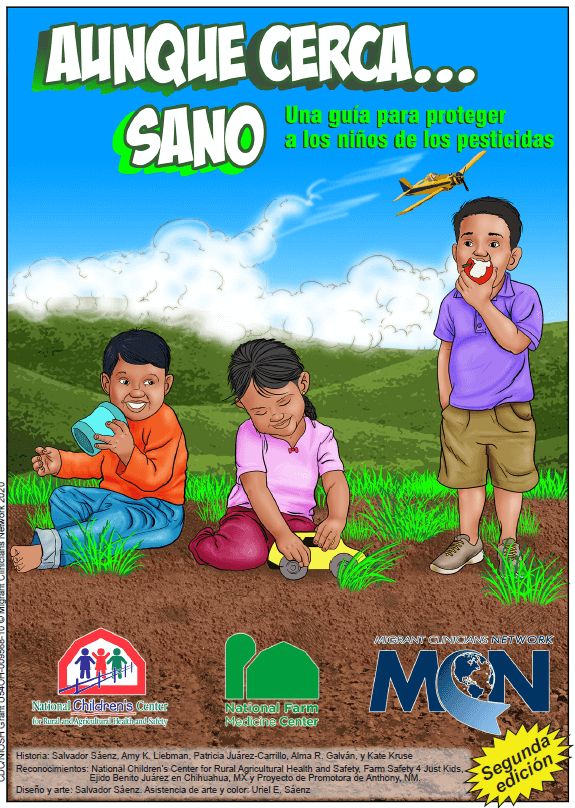
Pesticides Nearby But Healthy: A Guide to Protect Children from Pesticides is an illustrated pesticide safety comic book from Migrant Clinicians Network created for migrant and seasonal farmworker families. It helps parents and families understand children’s risk of pesticide exposure and ways they can reduce that exposure and protect their children’s health.
Written in an engaging, easy-to-understand format, the comic can be used for pesticide safety education, farmworker and agricultural worker outreach, parent education, community health programs, and environmental and occupational health education. It can also serve as an educational resource for community health workers, promotores de salud, outreach workers, clinicians, and others who work with agricultural communities.
In 2026, the Hawai'i Department of Agriculture and Biosecurity partnered with MCN to translate the comic into five additional languages. We are proud to offer these translations and celebrate the partnership as an example of how agencies, organizations, and communities can build on existing educational resources to increase access for workers and families with diverse language needs.
The comic is available to download at no cost and can be shared digitally or printed for use with farmworker families and communities.
We are currently "sold out" of our printed pesticide comic book. We are looking for additional funding. In the meantime, please download an e-copy.
Files
- PesticidesNearbyButHealthyENG_2007_0.pdf (1.33 MB)
- AUNQUE-CERCA-SANO-2020_PRINT.pdf (21.69 MB)
- AUNQUE-CERCA-SANO_ZH.pdf (4.28 MB)
- AUNQUE-CERCA-SANO_KO.pdf (4.19 MB)
- AUNQUE-CERCA-SANO_TH.pdf (4.28 MB)
- AUNQUE-CERCA-SANO_TL.pdf (4.14 MB)
- AUNQUE-CERCA-SANO_ILO-PH.pdf (4.13 MB)
A Spanish language trifold with pesticide safety information.
Files
- TrCaptico_pesticidas.pdf (7.28 MB)
copy deeplink ¡Fuera los Quimicos! ¡Ya Llegó la Alternativa!
¡Fuera los Quimicos! ¡Ya Llegó la Alternativa!A Spanish language comic books that explains the dangers of pesticides and offers practical, less toxic approaches to pest control. Produced by the Center for Environmental Resource Management at UTEP.
Files
copy deeplink A Little Bit of Poison...Will It Kill You?: Comic book and Manual
A Little Bit of Poison...Will It Kill You?: Comic book and ManualThe manual is a guide that can be used by community workers, educators, and health promoters for their educational activities in the community. It provides information on the risks of exposure to environmental contaminants and pesticides and ways to reduce those risks. It also includes useful information and tips for working in the community.
As for the comic book, community workers, educators and health promoters can use it as an educational tool to inform their community about the risks of environmental contaminants and pesticides.
Files
- pocovenenocomicless20.pdf (16.8 MB)
- A LITTLE POISON WILL IT KILL YOU_June-2019.pdf (5.14 MB)
- Poco Veneno No Mata 2nd Edition - June2019.pdf (5.27 MB)
Pesticide and Pregnancy Handout, English and Spanish, from the Wake Forest University School of Medicine.
Files
- PesticideandPregnancyHandoutEnglish.pdf (3.45 MB)
- PesticideandPregnancyHandoutSpanish.pdf (3.79 MB)