This article is eligible for 0.5 Continuing Education Credit. Please click here to complete the assessment to receive your credit or certificate of completion. This assessment is available through January 21, 2026.
Learning Objectives:
- Summarize the current state of H5N1 in United States agricultural operations.
- Synthesize the clinical guidelines for the identification, prevention, and treatment of H5N1 and seasonal influenza.
- Identify resources and best practices that can be used to address H5N1 and seasonal influenza among Spanish-speaking workers on dairy and poultry operations.
Influenza viruses evolve over time. In the last few years, epidemiologists have watched as the highly pathogenic avian influenza A virus, known as H5N1, HPAI, or avian flu, jumped species. In March 2024, H5N1 was detected for the first time among dairy cattle, after years of ongoing outbreaks among poultry operations across the nation. During this period, many non-traditional hosts were also infected, including birds of prey, bears, domestic cats, and marine mammals. The virus, however, is not new. Since 2022, at least 1,773 outbreaks of H5N1 have been reported on poultry operations, affecting over 181 million birds. Since its jump to dairy cows in 2024, there have been 1,081 confirmed cattle premises reported in 18 states. In 2025, the virus has continued to spread, most recently with Nebraska registering its first cases of H5N1 among cattle in September but mostly in poultry (commercial and backyard flocks) over the past 30 days.
There remains no known human-to-human spread in the United States, and the risk to the general public continues to be considered very low. However, workers exposed to potentially infected animals have a higher risk of infection, and 70 total human cases have been confirmed. These cases were attributed mostly to close contact with infected poultry or dairy cattle. Consequently, clinicians serving agricultural communities, particularly those with dairy operations, must develop a differential diagnosis when a patient or community member has flu symptoms. In this article, we discuss the basics of H5N1 on dairy operations, the risks to workers, how to lower that risk, and the signs, symptoms, and treatment protocols for H5N1.
H5N1 Among Farm Animals
H5N1 presents differently in cattle than in poultry. When a chicken contracts H5N1, it typically dies. To stop the spread, poultry operations often preemptively cull thousands of birds. When a cow contracts H5N1, however, the infected cow’s symptoms are less stark. Dairy workers may notice decreased appetite, decreased milk production, thickened or clotted milk, tacky or loose feces, lethargy, dehydration, and/or fever. Morbidity is very low from the virus among dairy cows. Unlike poultry, where wild birds like migrating geese are believed to be the primary transmission pathway, animal and human movements have been identified as the most likely transmission pathways on dairy operations. Vehicles can transmit the virus when dairy operations are visited by the same deadstock hauler, feed trucks, or milk trucks. Dairy operations have imported H5N1by acquiring cattle from infected herds from other operations. Human movement also increases the risk of spread when workers contract the virus. Workers sometimes work on more than one dairy operation, or workers from different operations may share housing, inadvertently spreading the virus between farms. Cats, a common farm resident that may also be spreading the virus, are highly susceptible to H5N1, causing noticeable illness and, oftentimes, death.
H5N1 Among People: Symptoms, Recognition, and Treatment
Many people – not just dairy workers – are at risk of exposure to H5N1 from dairy and poultry operations. Slaughterhouse workers, veterinarians, workers caring for sick animals, community health workers visiting agricultural sites, milk truck haulers, people at farm events or fairs that feature live animals, and consumers of raw milk may be exposed to the virus. (See side bar on raw-milk products.)
H5N1 symptoms are often mild, or infected patients may be asymptomatic. Among symptomatic cases, patients may experience flu-like symptoms including fever, runny nose, chills, fatigue, and joint aches. Conjunctivitis/red eyes is a common symptom of H5N1 that should raise a clinician’s concern of the virus.
In the process of creating the differential diagnosis, clinicians should take a thorough occupational and environmental history to uncover exposure to dairy operations. MCN recommends using our Environmental and Occupational Health Screening Questions for Primary Care, which are available in Spanish and English, for getting to know the patient and understanding the environment in which they are working, and the exposures they sustain. (See Resources.) The three primary questions are:
- Describe what you do for work – including where you work and your specific tasks at work.
- Are there any physical activities that you do – at work or away from work – that you feel are harmful to you?
- Are you exposed to chemicals, fumes, dusts, noise, and/or high heat at your work or away from work? Do you think they are harming you?
H5N1 is not part of the typical virus panel, however, as one of the Influenza Type A strains, a viral panel that shows a negative test for Influenza Type A rules out H5N1. For H5N1-specific testing, lab testing is primarily conducted by state departments of health. If a patient has suspected H5N1, begin treatment immediately (see next paragraph) and contact the state’s health department to arrange for a collected specimen to be tested for H5N1.
CDC currently recommends that workers who are exposed to sick cows or poultry but are not experiencing symptoms should be tested. Anti-viral post-exposure prophylaxis with oseltamivir (Tamiflu) is recommended for asymptomatic workers with high-risk exposure, especially those who did not wear adequate personal protective equipment. Workers who are sick with known exposures should be started on oseltamivir, twice daily for five days, as soon as possible. Clinicians are reminded to wear personal protective equipment when working with exposed and ill workers.
Dairy Workers: Routes of Exposure, Tasks in the Dairy Operation
Workers on dairy operations have a wide range of tasks, with varying levels of risk. Some common job tasks include:
- Milking cows
- Moving cows
- Treating cows
- Feeding cows
- Scraping cow pens
- Feeding and caring for calves
- Operating skid loaders to transport cow feed
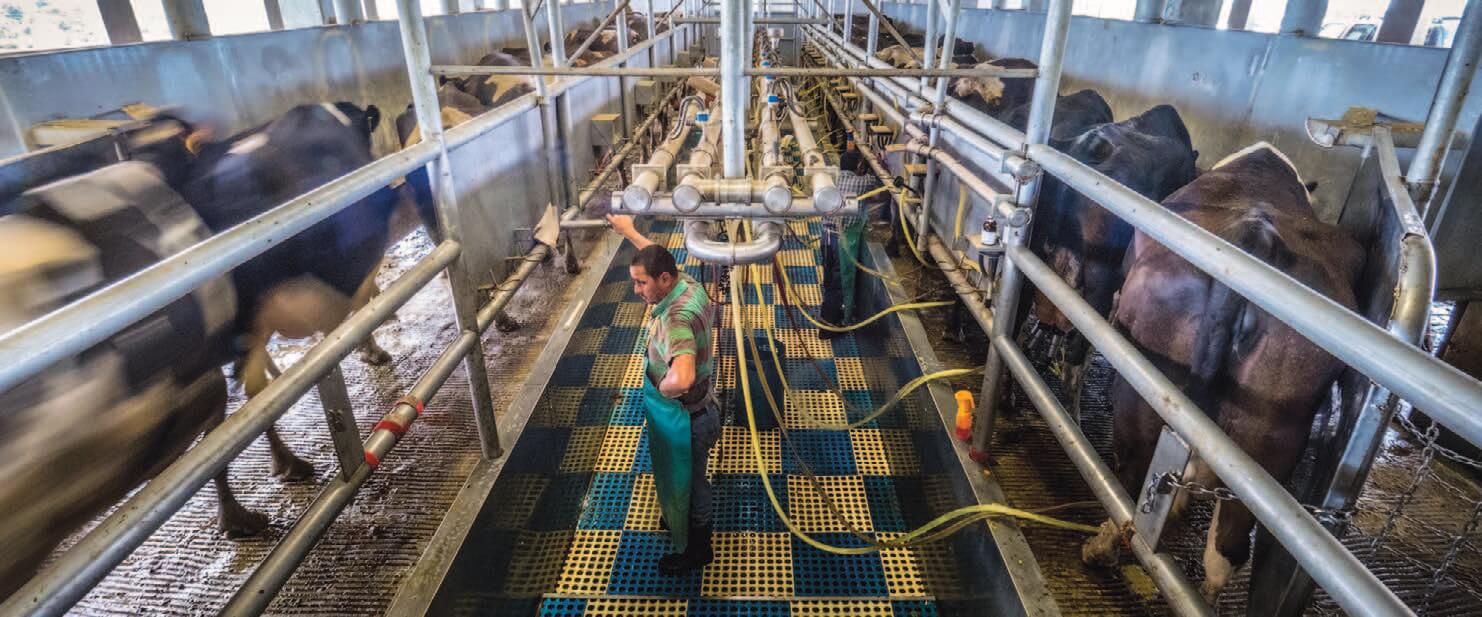
Mammary glands (the udder) of infected cows shed a significant amount of virus. There is some virus present in manure. Milking, and tasks that bring a worker in contact with milk and dairy cow udders, are activities that are the highest risk of H5N1 exposure. Dairy operations typically have machinery to milk cows, bringing the udder up to eye level of the worker, which may increase risk, as droplets of milk splatter on the eyes, nose, and mouth. Contaminated milk on hands or gloves can be another route of exposure, when workers bring their hands to their eyes, nose, or mouth. Workers who are handling cows, but also those who are scraping feces, cleaning milk machinery, and otherwise handling bedding or feed that have been used by infected cows, are at risk.
How to Prevent Exposure: Two Lines of Defense:
1) Prevention: Training and Administrative Controls
Prevention is the first line of defense. Worker trainings are essential to equip workers with the knowledge they need to understand how the virus spreads and how to avoid exposure, as well as what the symptoms are, and what steps to take if they fall ill. Dairy operations that employ Spanish-speaking workers who were not born in the US are responsible for most of the US milk supply. Many workers have limited formal education, are relatively isolated from the larger community, may be separated from their families who are living in their home countries, prefer other languages besides Spanish (including indigenous languages), live in unsafe housing, lack health insurance, or lack familiarity with the US health system. Some have never received safety training on the job in their language, and most have jobs on dairy operations that have significant health and safety risks, including H5N1. Worker trainings must take into account these and other factors unique to dairy workers, so that the trainings are relevant, understandable, and actionable.
For example, MCN, the National Farm Medicine Center and the Upper Midwest Agricultural Safety and Health Center (UMASH) created Seguridad en las lecherías, a Spanish-language curriculum, specifically to assist dairy workers to stay safe at work. The curriculum uses a train-the-trainer model, in which a trusted peer, like a local community health worker, trains the workers themselves in Spanish using the materials provided. This peer-trainer approach with relevant training materials is recommended for successful infectious disease prevention trainings.
The topics in the Seguridad training give workers a strong foundation in staying safe in dairy operations, taking into account the many factors that affect this worker population:
- Introduction to hazards
- Animal handling
- Machinery and equipment
- Workers’ rights and responsibilities
- Chemical safety and confined spaces
UMASH together with MCN is updating to curriculum to broaden its infectious disease content, including H5N1 risks.
H5N1 layers new challenges atop the pre-existing health risks related to dairy production – and the risks are still beginning to be understood. H5N1 transmission dynamics are still not fully understood. Different states, and different producers, may have varying norms, standards, and regulations, which complicate the picture further. MCN provides H5N1-specific training materials in Spanish including a two-page handout and videos in Spanish. Visit our Avian Flu page for access: https://www.migrantclinician.org/avian-flu.html. Additional resources are listed at the end of this article.
CDC recommends other administrative controls beyond worker training, including: monitoring and testing animals; monitoring workers for illness; providing workers with paid time off to support workers who are sick; testing workers who have developed symptoms or had unprotected exposure; provide safe storage for workers’ items; and provide workers with the ability and time to maintain hygiene, like providing hand washing stations and building in additional breaks for personal hygiene.
2) Personal Protective Equipment
Personal protective equipment (PPE) is another important line of defense. In high-exposure environments, for example in a dairy operation with active cases, CDC recommends fluid-resistant coveralls, a NIOSH-approved respirator like a N95, safety goggles, a head cover, disposable gloves, and boots or boot covers. As dairy operations are wet environments with large animals, most workers are already using some PPE, particularly fluid-resistant aprons and boots. Face shields can be particularly useful to keep moisture off of a respirator. During situations where active H5N1 infections are occurring in cattle, N95 respirators should be provided and many local health departments can actively provide PPE resources.
In hot, humid environments like summertime milking parlors, dairy workers are exposed for hours at a time to high heat environments where PPE is not just uncomfortable, but potentially dangerous, increasing the risk of heat illness. Dairy workers might avoid using PPE, or use it incorrectly, due to the discomfort and/or their work habits. Training on how to use PPE, therefore, must be accompanied with trainings on heat stress. Employers are recommended by CDC to adjust work schedules, ensure time for rest and hydration, and monitor worker well-being to confront the possibility of heat stress when PPE is used. Employers must provide the PPE to their workers. CDC has requested that state health departments make PPE available in workplaces where H5N1 may be present.
MCN has extensive resources on heat stress for workers, in English and Spanish, on the heat page: https://www.migrantclinician.org/explore-environmental-and-worker-health/heat.html.
3) Other Controls
Other controls exist for dairy operators and producers to follow. CDC outlines several recommended engineering controls for dairy operations including using a good ventilation system, and using milking systems with automated features to reduce worker contact with mammary glands. USDA has extensive information on its site on the biosecurity measures to follow. Clinicians can get to know these additional aspects and share them with workers, so that workers are aware of the best practices that operations are expected to follow. Clinicians can get to know these additional aspects and share them with workers, so that workers are aware of the best practices that operations are expected to follow.
The Importance of the Flu Vaccine
There is presently no available vaccine to prevent H5N1; however, new vaccines are being developed. However, it is important for clinicians to encourage dairy workers and others in rural communities to vaccinate against seasonal influenza. On a theoretical level, an agricultural worker can become ill with the seasonal influenza (H1N1) and avian flu (H5N1), simultaneously. In such a theoretical situation, both viruses can “reassort” their genetic material, that can cause mutations, which could cause the virus to spread more easily or be more severe. To prevent this possibility, clinicians are encouraged to promote seasonal flu vaccination among dairy, poultry, and swine workers.
How to Receive Your Continuing Medical Education Credit:
This article is eligible for 0.5 of Continuing Nursing Education credit accredited by the American Nurses Credentialing Center (ANCC). To receive your credit, please complete the questions in the quiz on that webpage to demonstrate knowledge gained and provide your contact information. Questions must be submitted before January 21, 2026. For questions on your credit, please email contedu@migrantclinician.org.
This portion of this publication is supported by the Upper Midwest Agricultural Safety and Health Center. UMASH is one of twelve Centers of Excellence in Agricultural Disease and Injury Research, Education, and Prevention funded by the National Institute for Occupational Safety and Health (NIOSH) throughout the United States. Funding is provided through a cooperative agreement from NIOSH, U54OH010170 (2009-2027). Visit: https://umash.umn.edu/niosh-aff-program/.