Puerto Rico is a tropical archipelago with distinct climatic variations shaped by its geographic location. Climatic diversity is driven by several factors, but primarily by wind and the island’s mountainous topography, which causes an orographic effect,1 bringing heavy rainfall on windward mountain slopes when moist air cools as it rises, causing water vapor to condense, and clouds and rain to form. The leeward side of the mountains remain drier. This effect occurs across the island’s coastal regions, although it is less pronounced in the southern region. When air crosses over the Cordillera Central, the central mountain range, and into Puerto Rico’s southern valleys, it has already lost some of its moisture even as rain falls along the northern slopes. The air descending the slopes of the southern region is therefore drier than the air flowing through the northern region, contributing to lower rainfall. The southern region is predominantly dry and experiences extreme heat. For example, the Guánica Dry Forest shows a near-year-round water deficit, receiving less than 30 inches of precipitation annually, compared to 69 inches for the island overall and upwards of 200 inches in the rainforest, every year.2
Last year, in early July, multiple Puerto Rican municipalities, including the drier southern municipalities of Lajas and Guánica, were under an extreme heat advisory. Increases in extreme weather-related events pose a risk to these agricultural communities. Communities that are organized and have local leaders are better equipped to be resilient in the face of such climate threats. Community advocacy processes can empower communities to identify their challenges, explore possible solutions, and take action to implement them. Module 6 of the curriculum, Building Capacity Among Community Health Centers to Address Weather-Related Extreme Phenomena, offers advocacy tools for community leaders to strengthen agricultural communities in the face of environmental emergencies like extreme heat.
As the module details, advocacy is closely linked to community leadership. Community leaders must understand the needs of their community, promote mobilization and teamwork to find solutions, and communicate clearly and effectively with a defined purpose. Leaders must be interested in listening to and understanding community members’ concerns. Community leadership is grounded in a commitment to the collective well-being of the community, fostered through a special connection to that community. Unfortunately, there is a gap between community awareness and the ability to mobilize members to advocate for public policies that protect them from extreme heat events. Building leadership in agricultural communities to advance advocacy efforts is essential to foster healthier, more resilient communities in the face of extreme weather events.
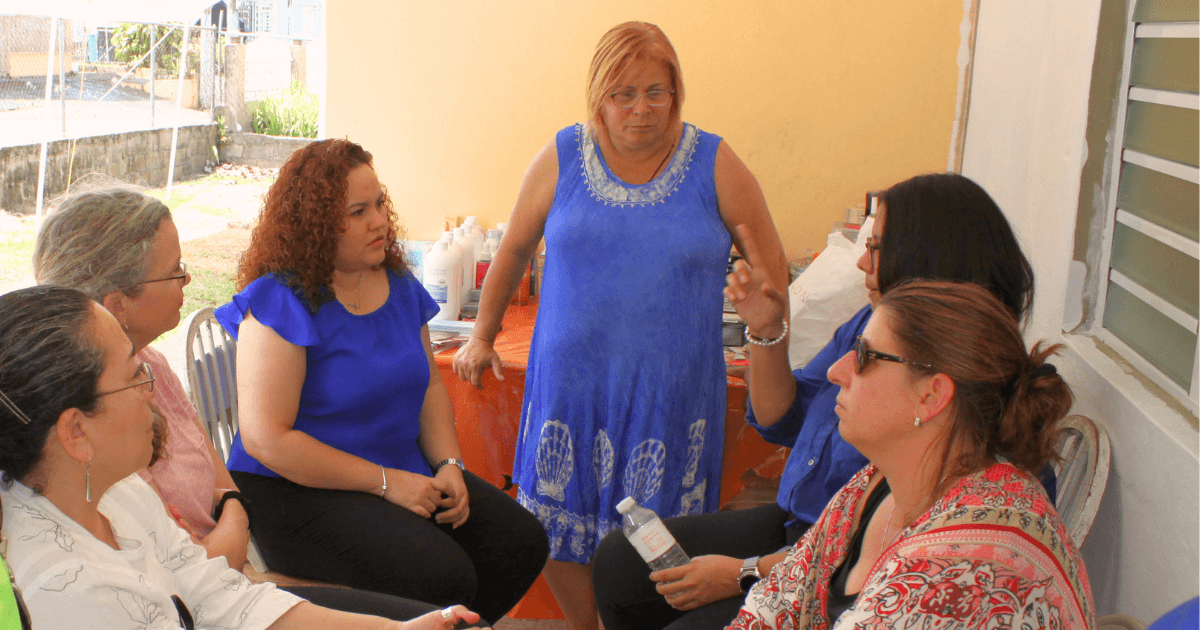
In an attempt to address this issue, we presented a community outreach activity on extreme heat just weeks before the extreme heat advisory, at a church in the Barrio Salinas de Lajas, in cooperation with MEDX, our partner community health center in this region. We completed a needs assessment prior to the activity. We found that the population faced barriers to participating in group activities, and had lower educational attainment. These findings align with data indicating that over 25% of adult residents had less than a high school diploma, and just 21% have a bachelor’s degree or higher.3 Most attendees were older adults, who received blood sugar screenings and had their blood pressure checked by a doctor at the event. One participant was blind, and others were patients living with arthritis and diabetes.
Given the weather conditions typical of municipalities in southern Puerto Rico and after planning and coordinating with the MEDX health center, it was deemed appropriate to offer an informational session on extreme heat, including symptoms and protective measures for both people and their pets. Participants also received an informational handout regarding heat, heat-related symptoms, and personal protection strategies. I was surprised that even as we discussed the health effects of extreme heat, two participants chose to remain away from the shade and expose themselves directly to the sun during the activity. Still, the community was engaged and learned about the effects of extreme heat, and they appreciated that we were there to support them.
To incorporate the advocacy module, participants were asked whether they agreed with promoting public policies in Puerto Rico that protect agricultural communities from extreme heat. All participants responded that they agreed. Although none were agricultural workers, they recognized that extreme heat affects everyone in one way or another -though not always in the same way.
Advocacy efforts require the involvement and support of the whole community – and this community training can act as a starting point in community engagement. Community leaders play a key role in advocating for the needs of their community members, which is why it is crucial to work with them and consider their recommendations. Recent advocacy leadership efforts have been successful in Puerto Rico. For example, a community took action against a coal plant in Guayama that continuously improperly disposed of its highly toxic coal ash waste. Community mobilization and advocacy were crucial to make change. Eventually, laws were passed that prohibited the disposal of coal ash or coal combustion residues in Puerto Rico.5-7
Similarly, advocacy can be central to strengthen agricultural communities in the face of environmental emergencies. Extreme heat advocacy in Puerto Rico includes a recent bill to set public policy to protect the population’s health and to support sustainable economic development amid extreme heat risks in Puerto Rico.4 In California, such advocacy efforts have succeeded, with the passing of a law that requires employers to provide free access to potable, cool drinking water, shade stations when temperatures exceed 80°F, short rest breaks, and monitoring procedures when temperatures exceed 95°F.8
Our educational activity in Lajas demonstrated that there is still work to be done. First, educational materials must be clear, adapted to the community’s culture, and responsive to the population’s needs. In other words, materials should be tailored to the specific population they are intended to reach -- in our case, older adults. Second, existing community resources should be leveraged to promote community-impact activities. Third, it is essential to identify community leaders who will support the community advocacy process. This reflects the idea that leaders must understand community needs to advocate against existing injustices. Finally, community members should be supported by sharing information about existing public policies that protect agricultural communities from extreme heat, and by developing educational strategies on the topic.
Health and safety concerns for outdoor workers during climate-related events have become increasingly urgent as extreme weather patterns intensify. The well-being of farmers and agricultural workers is essential to maintain food security. Community leaders often have deep knowledge on local issues, and play a key role in advocating for the needs of their community. It is crucial to consider their recommendations. Our training can be a starting point on the community’s path to effective advocacy.