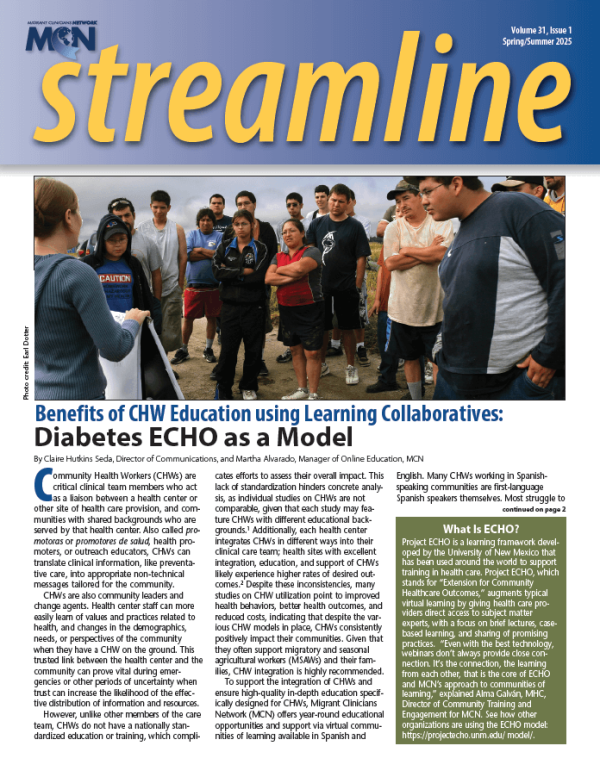
Suggested Dietary Parameters: What Are Participants Recommended to Eat (And Not Eat)? The intervention promotes a whole-foods plant-based diet where participants eliminate meat, dairy, eggs, and processed foods, and greatly minimize or eliminate added sugars, added fats and oils, and added salts. Recipes provided are focused on whole grains, beans and legumes, vegetables, fruits, herbs, and spices.
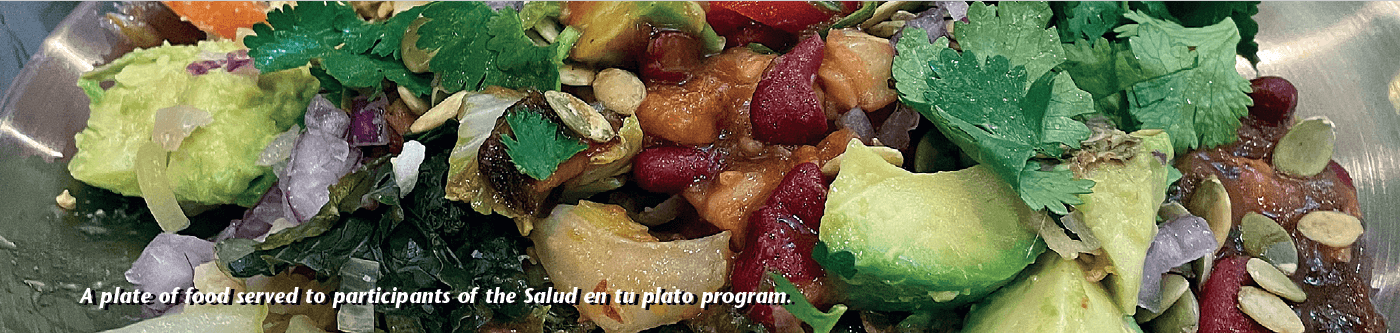
Salud en tu plato encourages participants to fill up their plates with one-quarter of a whole grain like corn tortillas, brown rice, quinoa, or hominy; one-quarter plant-based protein like pinto beans, lentils, chickpeas, tofu, or tempeh; and one-half vegetables like vegetable soup, green salad, sauteed broccoli, kale and mushroom stir fry.
Evidence is mounting on the effects of a whole-foods plant-based (WFPB) diet on overall chronic disease prevention and reversal. Among migratory and seasonal agricultural worker (MSAW) communities – where access to clinical care may be limited when they leave the service area for seasonal work, or because of lack of transportation, language, cost, or a lack of familiarity with the health system – a dietary overhaul can be an important and lifesaving intervention. Several of the leading causes of disability and death among MSAW communities and the US overall, including cardiovascular disease, type 2 diabetes, and certain cancers, are highly correlated to diet – and patients have an opportunity to make healthy choices at least three times a day at mealtime. Salud en tu plato, a diet intervention in the agricultural community of Watsonville, California, is showing that even a short-term change can help participants feel better and begin to envision better health. While the intervention is just two weeks, many continue month after month. And even the short-term participants find benefit: 90% of participants score high on readiness to continue, and 99% of participants show improvement in at least one biomarker after the two weeks.
“People do not like taking medications,” explained Maria Jose Hummel, PhD, MPH, program coordinator for Salud en tu plato, which is operated by the nonprofit Eat for the Earth. During the short two-week intervention, participants already start to feel better, with more energy and fewer aches, but “once you start telling them that this is something that can help them lower the dose of their medication,” their interest in following the diet long term increases. With dietary consistency after the intervention, “we’ve had some of our participants who have been able to get off their medications in a safe manner,” always under the supervision of their primary care provider, she noted. “They’re thriving without the need for the medication – and that appeals to people…. [They become] hopefully not so dependent on something that they may not have access to, especially if they don’t have insurance or can’t afford medication.”
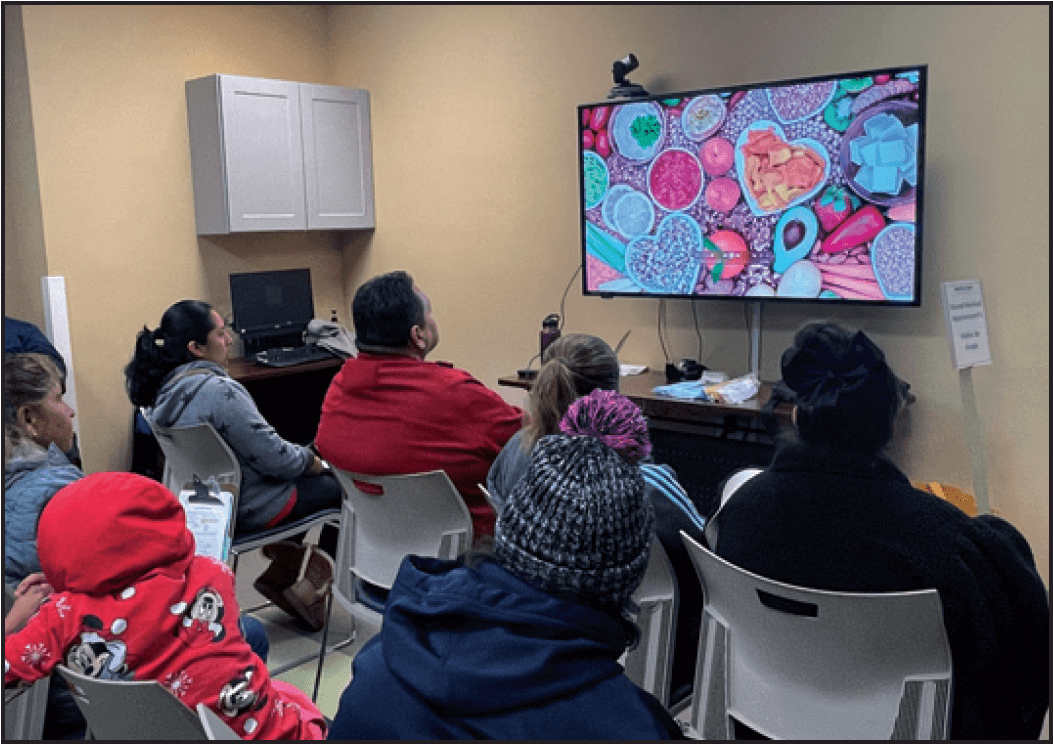
On a recent Sunday, 26 locals crowded into a small community room at Salud para la Gente, a community health center in Watsonville that has partnered with the nonprofit, waiting to get their vitals read. While the patients filled intake forms, videos of Hummel introducing healthy foods in Spanish while preparing WFPB meals and snacks like black bean brownies played on a large television. Many participants had been referred to the intervention by their primary care provider or a health coach at Salud para la Gente. Others arrived by word of mouth – friends, fellow churchgoers, or family members of former participants and volunteers, or people who ran into Salud en tu plato at a health fair. At least three in this cohort were repeat attendees, people who choose to do the intervention month after month.
The three-Sunday class starts with the introductory class, where volunteer clinicians take fasted participants’ glucose, LDL/HDL/non-HDL cholesterol, triglycerides, blood pressure, body weight, and BMI. Immediately after their lipid panel is taken, patients are encouraged to go to the next room in the health center, where Beth Love, the founder of Eat for the Earth, the nonprofit that sponsors Salud en tu plato, has been cooking all morning. On the first Sunday, participants had a sugar-free granola with fresh fruit and plant-based milk, a no-salt tofu scramble, mixed oil-free sauteed vegetables, posole, a “three sisters” vegetable stew, and lots of toppings, like cilantro, red onion, jalapenos, avocado, and pepitas, or pumpkin seeds. After eating, participants are individually counseled on their lipid panel results and the plant-based diet they are to pursue by either Hummel or Martha Sandoval, MD, the program’s medical director, who volunteers her time for the intervention, and who herself refers patients to the program.
When they return home, they begin to receive daily texts from Hummel in Spanish. The text has a link to a video. “Even people who don’t know how to read can click on a link,” she noted. The videos are professionally produced by a partner organization, providing information and recipes, or a cooking demonstration. Dr. Hummel also sends more information, recipes, and resources. Additionally, she calls each individual at least once to do a one-on-one check-in. Many send back photos of their plates – nopalito tacos with beans and pico de gallo, a lentil burger, breakfast oats with berries.
When they return on the second Sunday, Hummel teaches a class in Spanish about the mechanisms of heart disease, diabetes, and hypertension, and the way the WFPB diet they are pursuing in the intervention counteracts each health concern. She also answers more questions, and Love provides an "anti-inflammatory" green smoothie with printed-out recipes for participants to try at home.
On the last Sunday, participants return in a fasted state once more to see the results of the two-week intervention on their health numbers. Close to every participant will have improvement in one biomarker. “If we take care of diet, it will help with your blood pressure, with your LDL cholesterol – which is one measure that drops the fastest with our program. Our average is [a drop of] over 20%” in those two weeks, Hummel said. “Statins aren’t even going to do that.” Total cholesterol and fasting glucose see large drops as well. “it’s all connected, and once [participants] see that, they are motivated to do this on their own – nobody has to force them. I’m not a food cop. I’m not going to go into your house and tell you what to do. It’s your own choice, but these are the benefits.”
On that final day, food is once again a major component, with participants breaking their fast with oil- , butter-, and sugar-free apple and oat breakfast bars, fresh fruit, tacos with tempeh and kale, and a hearty bean soup that was topped with salsa verde, pico de gallo, herbs, and spices.
“One of the reasons people were open to trying our food was because a lot of them have a daughter or son who is vegan, and they say, ‘I don’t know what to make for them’ – and, of course, the other reason is, ‘my doctor told me I have to change my diet.’ So they were open. And that’s a shift I’ve seen in the last two years -- people have changed their mentality about eating a plant-based diet,” Hummel said. For the Watsonville community, the dietary shift may be easier than for other communities. Traditional foods like tacos with beans and salsas can easily conform to the diet. “For [participants with ancestors from] parts of Central America and Mexico, their ancestors were very tied to the earth, eating foods in their more natural states,” Hummel noted. “So this is something that at some level [participants] can relate to.” Hummel and Love provide ample recipes of familiar meals, made entirely of plants, low in sodium, and without added oil, or sugar.
Salud en tu plato began when Love envisioned a partnership with health care providers to support patients with chronic disease through plants. Eat for the Earth offered a pilot of the program, initially in English with Spanish interpretation, on an organic farm that was not on a bus line. Eat for the Earth then secured a grant to the county and city of Santa Cruz to reach the communities in the county with the highest burden of health issues; with that funding, Love brought in Hummel so the intervention could be tailored for the Watsonville community. Hummel and Love moved the classes from Saturday to Sunday, in recognition that most in the MSAW community worked six days a week. Hummel also began using text instead of email, because Hummel has found that most participants, particularly older Spanish-speaking participants, who is the largest segment of participants in the intervention, respond to texts better than to email. They also began a partnership with the health center, moving the classes to a familiar and easy-to-access central location, and offering the intervention in Spanish. Love encourages other health centers to make similar partnerships with community organizations, given time and finance constraints. “[Clinicians] aren’t going to be able to spend the time with patients to get them this information, so you have to look for people in your community” to make interventions like this happen, she said.
The intervention now has over two years of results. From June 2022 to June 2024, the average drop in total cholesterol was over 12.5%, and the average drop in LDL cholesterol was over 21%. They also saw smaller but still notable decreases in fasting glucose, triglycerides, blood pressure, weight, and BMI. “This is among all participants, regardless of dietary compliance,” Love clarified. “In our observation, those who follow the dietary parameters most closely generally have the best results. Among participants who are compliant, we have had many people go from really high measures into normal and even optimal ranges.” Because level of compliance to the diet is self reported, it is difficult to make definitive conclusions on the efficacy of the diet. Nonetheless, such drops without drug interventions and on such a short timeframe are noteworthy.
Resources: Learn More
- Eat for the Earth hosts an annual conference, Food as Medicine, in October 2025 in Santa Cruz, California. CMEs are available. www.foodasmedicinesantacruz.org.
- Viva Longevity! interviewed participants and followed Hummel while she counselled participants when they received their results after two weeks. Watch the video at: https://youtu.be/XJBtRwUD3a4?si=UpqVrES_-Dx2LMs1
- Salud Para Hoy, Hummel’s website, offers free recipes and videos, information, as well as her books for purchase, in Spanish. www.saludparahoy.com
Citations
1 Barnard ND, Cohen J, Jenkins DJ, et al. A low-fat vegan diet improves glycemic control and cardiovascular risk factors in a randomized clinical trial in individuals with type 2 diabetes. Diabetes Care. 2006 Aug;29(8):1777–83. doi: 10.2337/dc06-0606.
2 Ornish D, Brown SE, Scherwitz LW, Billings JH, Armstrong WT, Ports TA, McLanahan SM, Kirkeeide RL, Brand RJ, Gould KL. Can lifestyle changes reverse coronary heart disease? The Lifestyle Heart Trial. Lancet. 1990 Jul 21;336(8708):129-33. doi: 10.1016/0140-6736(90)91656-u. PMID: 1973470.
3 Preventative Medicine Research Institute. Website. Available at: https://pmri.org/