Includes EPA manual "How to Comply With the 2015 Revised Worker Protection Standard For Agricultural Pesticides - What Owners and Employers Need To Know" and an excerpt specifically for clininicians regarding medical evaluation and respirator fit test. See also the medical evaluation questions in English and Spanish.
Download Resource
An educational comic book on the prevention of zoonotic illnesses. Developed by MCN in collaboration with Ohio State University.
Download Resource
- Working with farm animals_1.pdf (13.33 MB)
- Trabajos con animales en un rancho_1.pdf (13.31 MB)
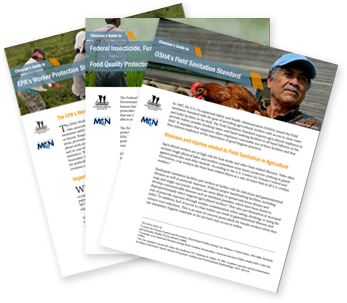
MCN and Farmworker Justice offer these guides to assist clinicians in understanding farmworker health and safety regulations. OSHA’s Field Sanitation Standard; EPA's Federal Insecticide, Fungicide, and Rodenticide Act (FIFRA); EPA's Food Quality Protection Act (FQPA); EPA’s Worker Protection Standard (WPS).
Download Resource
- OSHA's Field Sanitation Standard Clinician's Guide.pdf (747.53 KB)
- FIFRA FQPA Clinician Guide.pdf (287.9 KB)
- WPS Clinician's Guide.pdf (843.35 KB)
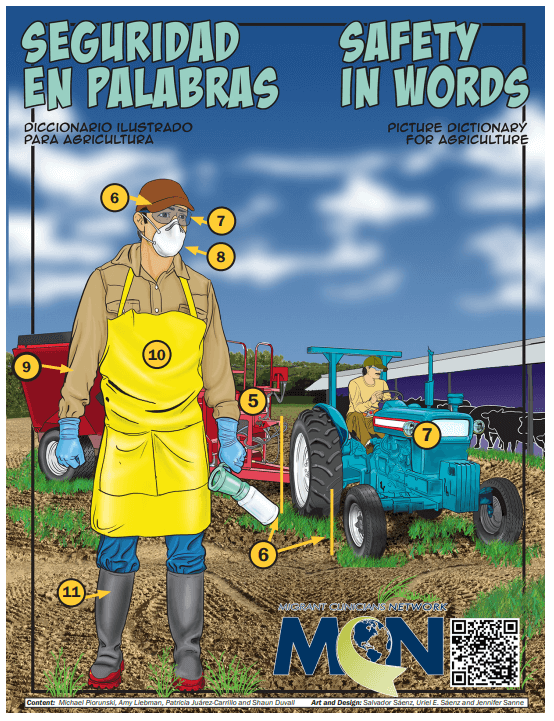
Este diccionario ilustrado bilingüe de MCN, "Seguridad en Palabras/ Safety in Words", muestra los peligros que hay en el lugar de trabajo y las mejores prácticas para la salud y la seguridad en la agricultura. Desarrollado con el apoyo del Programa de Subvenciones Susan Harwood de OSHA, este recurso refuerza el vocabulario en inglés de los trabajadores que hablan español lo que ayudará a prevenir lesiones en la agricultura.
Download Resource
This colorful bilingual comic addresses workers' compensation and immigrant dairy farm workers’ rights and responsibilities. It tells the story of a Mexican dairy farm worker who is injured on the job and the steps he and his employer take to make sure he receives his benefits, and the farm improves its safety.
Download Resource
- DairyWrkrRightsWrkComp_ENG2016_web.pdf (7.78 MB)
- DairyWrkrRightsWrkComp_ESP2016_web.pdf (7.92 MB)
- COMIC - Safety and Health on the Farm - New Mexico - English.pdf (3.4 MB)
- COMIC - Safety and Health on the Farm - New Mexico - Spanish.pdf (3.41 MB)
- COMIC - Safety and Health on the Farm - New York - English.pdf (3.45 MB)
- COMIC - Safety and Health on the Farm - New York - Spanish.pdf (3.46 MB)
- COMIC - Safety and Health on the Farm -Minnesota -English.pdf (7.78 MB)
- COMIC - Safety and Health on the Farm - Minnesota - Spanish_0.pdf (7.91 MB)
MCN's Director of Environmental and Occupational Health, Amy K. Liebman, appeared on the radio broadcast Epicenter: West Marin Issues on KWMR 90.5 FM to talk pesticides and the Worker Protection Standard. Liebman was joined by Hector Sanchez of the Labor Council for Latin American Advancement. Host Frederick Smith discusses with Liebman and Sanchez a variety of pesticide-related issues, including protections for farmworkers and their families, farmworkers' risks of pesticide exposures, how pesticides are regulated, their health effects on farmworkers and their families, and what healthcare providers can do to mitigate, diagnose, manage, and report pesticide exposures.
During the interview Liebman referenced the Agricultural Health Study, which is available here.
Links
- http://kwmr.org/show/186
- http://kwmr.org/show/186','','location=yes,scrollbars=yes,menubar=yes,resizable=yes,width=960,height=720,left='+(screen.availWidth/2-480)+',top='+(screen.availHeight/2-360)+
- http://www.lclaa.org/
- http://aghealth.nih.gov/
- http://aghealth.nih.gov/','','location=yes,scrollbars=yes,resizable=yes,width=960,height=720,left='+(screen.availWidth/2-480)+',top='+(screen.availHeight/2-360)+
- https://w.soundcloud.com/player/?url=http%3A//api.soundcloud.com/tracks/108699853
Señales y síntomas de envenenamiento por pesticidas
Developed by the California Poison Control System in collaboration with the Western Center for Agricultural Health and Safety at the University of California, Davis and the California Department of Pesticide Regulation
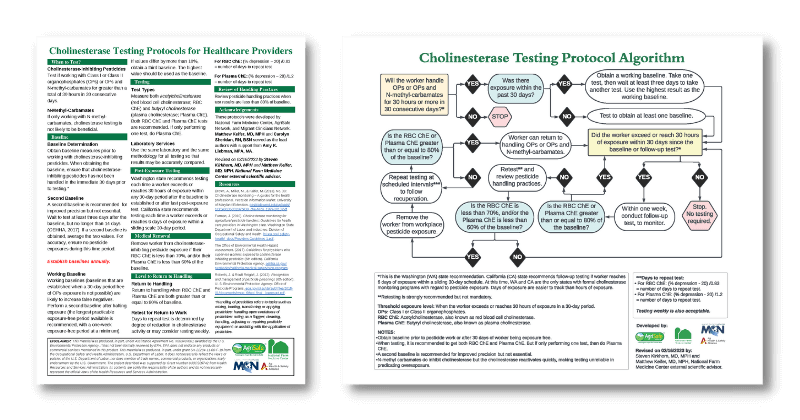
These Cholinesterase (ChE) clinical tools provide a concise and simple format to guide clinicians in monitoring the ChE levels for patients working with Class I and Class II organophosphates (OP) or OP and N-methyl-carbamates.
Download Resource
MCN's Pesticide Clinical Guidelines and Pesticide Exposure Assessment Form assist in the recognition and management of acute pesticide exposures in primary care settings.
The pesticide guidelines were adapted from guidelines developed by Dr. Dennis H. Penzell, a former medical director of a Community and Migrant Health Center with experience in large-scale pesticide exposure incidents.
The Acute Pesticide Exposure Form was adapted from the data collection on an acute pesticide exposed patient tool developed by Matthew C. Keifer, MD, MPH, Director of the National Farm Medicine Center, appearing in the EPA's Recognition and Management of Pesticide Exposures, 6th Edition, EPA 2013.
These resources were developed with guidance from MCN's Environmental and Occupational Health Advisory Committee - a panel of healthcare professionals and researchers with expertise in pesticides and migrant health.
Download Resource
- PesticideClinicalGuidelines_2014Nov.pdf (395.73 KB)
- 2022-Pesticide-Exp-Assessment_ENG.pdf (316.56 KB)
- 2016-08-16 - Acute Pesticide Exposures Clinical Guidelines (Spanish).pdf (203.88 KB)
- 2022_Pesticide-Exp-Assessment_SPA.pdf (626.33 KB)
The importance of clinical diagnostic tools and biomonitoring of exposures to pesticides as well the role of clinicians in pesticide reporting and the challenges clinicians face in accurately diagnosing patients exposed to pesticides are described in a presentation by Matthew Keifer, MD, MPH and Amy K. Liebman, MPA. Click on the link for an APHA policy resolution underscoring the need for clinical diagnostic tools and biomomitoring of exposures to pesticides. This policy supports the information outlined by in the presentation.
Download Resource
Outlines the knowledge and skills that health professionals need to have about pesticides. This document is part of a national initiative aimed at ensuring that pesticides issues become integral elements of education and practice of primary care providers. English and Spanish
Download Resource
- NEETFPesticidePracticeGuidelines.pdf (2.04 MB)
- NEETFHabilidadesParaLaPracticaPesticidas.pdf (668.29 KB)